NNAT Test vs CogAT: What Each Score Report Means
The NNAT and the CogAT are both ability tests districts use to screen for gifted and advanced programs, but they measure different things. A score on one does not translate to a score on the other.

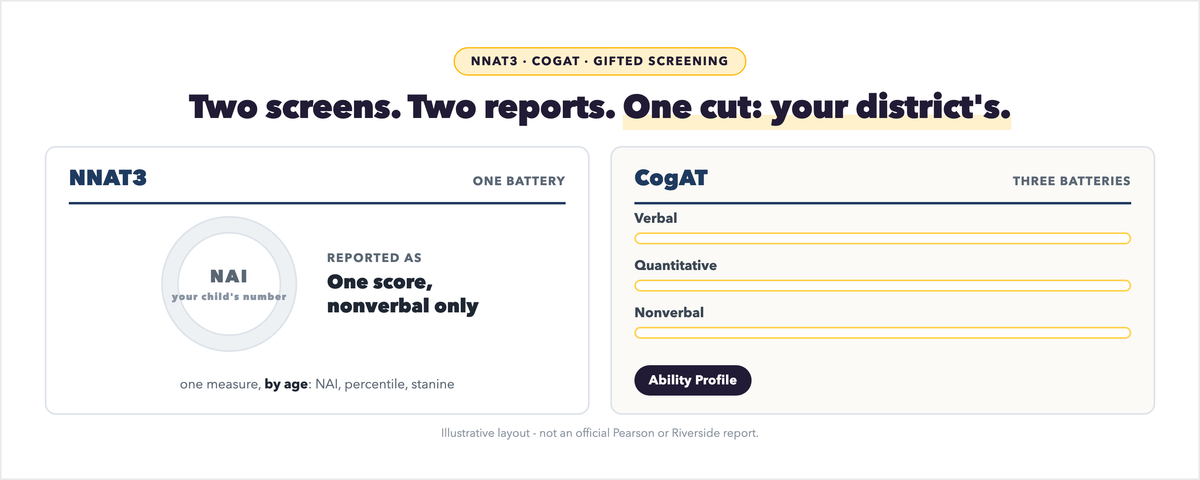
The NNAT and the CogAT are both ability tests districts use to screen for gifted and advanced programs, but they measure different things. The NNAT3 (Naglieri Nonverbal Ability Test, Third Edition) is a nonverbal test: 48 picture-pattern questions, 30 minutes, one score reported several ways. The CogAT (Cognitive Abilities Test) measures verbal, quantitative, and nonverbal reasoning in three separate batteries, and its Complete Battery report carries a score for each plus a composite and an Ability Profile.
So a score on one does not translate to a score on the other. The only number that decides anything is the one your district reads, on the test it gives, against the bar your district sets, whether that is a printed cut score or a set of measures. A cut score is the score a district requires.
What each test measures
The NNAT3 is, in Pearson's words, a nonverbal measure of general ability: picture patterns, no words. Pearson, its publisher, prints the full line: the test is "a nonverbal measure of general ability for students in kindergarten through grade 12." Every question is a diagram, a progressive matrix where the child figures out the pattern and picks the piece that completes it. The directions are pictures too. Pearson's own words: the test "uses pictorial directions and requires no spoken or written language." A child's vocabulary, reading level, and first language do not sit between the child and the questions.
The levels run by grade: a kindergartner takes Level A, a third grader Level D, a tenth grader Level G. Every level has 48 multiple-choice items and takes 30 minutes. Districts give it to a group, online or on paper, once or twice a year, usually in the fall and early spring.
The CogAT measures three things. Riverside Insights, its publisher, describes it as a test that "measures verbal, quantitative, and nonverbal reasoning." The Complete Battery is three batteries, Verbal, Quantitative, and Nonverbal, with three short subtests each. The brochure puts the whole thing at less than two class periods. Levels 5/6 through 8 (grades K-2) are entirely picture-based. From grade 3 (Level 9 and up), the verbal and quantitative questions are text. If you want the grade-by-grade shape of that test, our CogAT by grade guide walks kindergarten through grade 3, and the CogAT guide covers what it measures and when districts give it.
Some districts give the shorter CogAT Screening Form, about 30 minutes, which returns one composite and no Ability Profile; if your child's report shows one number and no profile, that is what was given.
How the two score reports read
An NNAT3 report gives you one measure, expressed several ways. Pearson's product page lists the scores it reports: the Naglieri Ability Index (NAI), percentile ranks (the share of children the same age who scored below yours, out of 100), stanines (a 1 to 9 scale built from the percentile; 5 is the middle), scaled scores, and normal curve equivalents, all by age. Those are five ways of placing the same performance against children of the same age, not five different abilities. The parent report, which Pearson provides in English and Spanish, explains what the scores are for and shows item examples.
A CogAT report gives you three measures and a profile. Each battery gets its own Standard Age Score and Age Percentile Rank. Both are set against national norms by age in years and months, and districts can add local norms. Then the Ability Profile: the brochure calls it a "succinct summary of each student's cognitive ability, areas of strength, and areas of opportunity," and says parents can enter it at CogAT.com to read what it means. Riverside's family resources page lists an Ability Profile Finder for exactly that.
Side by side:
| NNAT3 | CogAT (Complete Battery) | |
|---|---|---|
| What it measures | Nonverbal reasoning only | Verbal, quantitative, and nonverbal reasoning |
| Length | 48 items, 30 minutes | Nine subtests, less than two class periods |
| Language load | None: picture directions, picture items | Picture-based through grade 2; verbal and quantitative items are text from grade 3 |
| Main scores | Naglieri Ability Index, percentile rank, stanine, by age | Standard Age Score and Age Percentile Rank per battery, plus composite |
| Profile | None | Ability Profile (Complete Battery only) |
For the math ideas behind grade-level reasoning, Cuemath's free concept explanations go one idea at a time.
Which test your district uses
Districts choose, and the choice is not always on the district's page. Four patterns from district pages:
- Irvine Unified gives the NNAT to third graders as the ability measure in its GATE screen, alongside measures that include state test scores, STAR Reading and Math, and a writing sample. The district's page lists the measures and does not say how it weighs them, only that the top 20% of each grade level qualifies for GATE services; ask the school's GATE coordinator. The NNAT comes in third grade and GATE services run in grades 4 to 6.
- Fairfax County currently names its instrument only as a "nationally normed ability test." The last time it named them was the 2024-25 cycle: CogAT in October, NNAT in November, CogAT again in March. Our Fairfax AAP guide has the entry points and dates.
- Frisco ISD runs district-wide CogAT windows that feed gifted screening for grades 1, 3, and 5. Plano ISD's Math Rocks uses multiple measures, including a MAP math score and CogAT Quantitative and Nonverbal scores; there is no application. Both are on our Frisco and Plano pages.
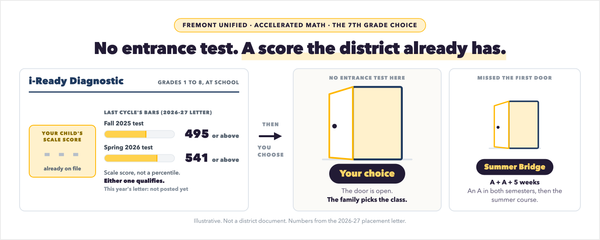
- Fremont Unified gives neither. Its CogAT testing funding was cut in February 2020, and its 2025-26 update states there is no GATE eligibility test.
To find yours, open the district's gifted or advanced-academics page and look for the test name next to the screening window. If the page says only "ability test," ask the school's gifted coordinator which one, because the district's bar is set on one of them. Neither test has a parent sign-up: Riverside Insights does not register children for the CogAT, and Pearson describes the NNAT3 as a tool for educational professionals. The gifted referral deadlines guide shows how to find the window itself.
What a score on one says about the other
Nothing you can bank on. Both reports carry a score set by age and a percentile, so they look comparable. But they are built from different questions and different comparison groups: picture patterns alone on the NNAT3, and word, number, and figure reasoning scored separately on the CogAT.
Two consequences. First, a district that gives the NNAT one year and the CogAT the next has not given your child the same test twice; the numbers can move without the child changing. Second, Pearson has updated the NNAT3 norms, and for the 2026-27 school year a district may use either the new norms or the previous set. Pearson's own note: a shifted percentile "does not mean the student's underlying performance changed; it means the comparison group has been refreshed." If a percentile surprises you, the first question is which norms the report used.
Know where your child's math reasoning stands
A free Cuemath MathFit evaluation is a 55-minute, one-on-one session. It cannot move a district's decision, and it is not a practice test for either screen. It is a reading of where your child's math reasoning stands in grade-level work right now, whichever screen the district gives.
Book a Free EvaluationFor students in Grades K to 12 worldwide.
FAQs
Is the NNAT easier than the CogAT?
Neither is the easier test; they ask different questions. The NNAT3 is 48 picture-pattern items with no reading. The CogAT Complete Battery is nine subtests, and from grade 3 its verbal and quantitative items are text. A child who reasons well with shapes but reads slowly can post a higher percentile on the NNAT than on a CogAT verbal battery. A child with strong word reasoning can do the reverse. The district's cut score sits on whichever test it gives.
My child took the NNAT in one district and the CogAT in another. Can I compare the two scores?
Not directly. Both report a score set by age and a percentile, but against different content and different comparison groups. A district compares only on its own instrument. If you are moving, carry both reports and ask the new district which test and which cut score it uses; the CogAT nonverbal battery is the closest match to the NNAT, and even that is not a conversion.
What is the Naglieri Ability Index?
The NAI is the NNAT3's main score, set by age: it places your child's result on a fixed scale so it can be compared with children of the same age. None of Pearson's pages we read prints the NAI's average or spread, so the only bar to read it against is your district's cut score. Pearson reports it alongside percentile ranks, stanines, scaled scores, and normal curve equivalents. All of them describe the same 30-minute performance against children of the same age; none of them is a separate ability score. If your district uses the NNAT, check whether its page writes the cut score as an NAI or as a percentile.
What is a CogAT Ability Profile, and does the NNAT have one?
The Ability Profile is a CogAT-only summary of a child's strengths and opportunities across the verbal, quantitative, and nonverbal batteries. Riverside says it is unique to the Complete Battery and that parents can enter the profile at CogAT.com to read what it means. The NNAT3 has nothing like it, because it reports one nonverbal measure; there are no batteries to compare with each other.
Why did my child's NNAT percentile change when nothing else did?
Pearson updated the NNAT3 norms, and for the 2026-27 school year districts may use the new norms or the previous set. A percentile compares your child to a reference group; when the group is refreshed, the percentile can move while the child's performance does not. Ask the district which norm set the report used, and whether the cut score was set on the same one.
Does the CogAT Screening Form give the same scores as the full test?
No. The Screening Form is the analogies subtest from each battery, and it produces one composite score. The separate verbal, quantitative, and nonverbal Standard Age Scores, and the Ability Profile, come from the Complete Battery or from Riverside's Post-Screener option.