How to Read Your District's Math Placement Rules in an Afternoon
Your district's math placement rules are on its own website, almost never on one page. Of the fourteen districts this blog has read, thirteen decide on a test score, eight also count grades, five also count a teacher's word, and thirteen print a window or deadline.

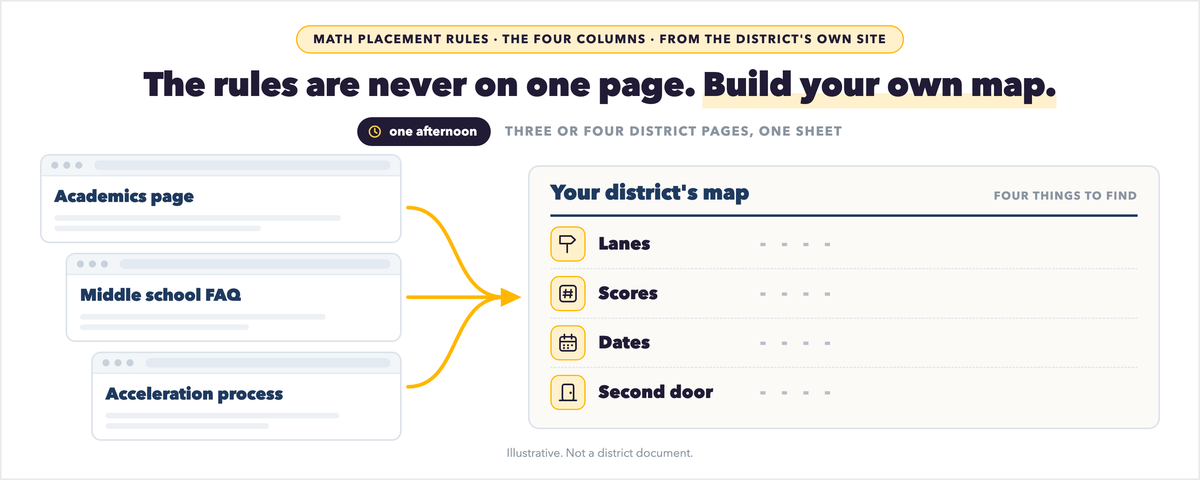
Your district's math placement rules are on its own website, almost never on one page. Of the fourteen districts this blog has read, thirteen decide on a test score, eight also count grades, five also count a teacher's word, and thirteen print a window or deadline. Most decide in the spring of 5th or 6th grade, for a 6th or 7th grade course. One gates on no test at all: its middle school math is open to anyone. Your district's version sits across three or four of its pages, in four columns: the lanes, the printed scores, the dates, and the second door. That last one is the route in for a child who missed the first one. An afternoon is enough. A blank column is a finding, not a failed search. Below is the method. Then the four columns, filled in for a district this blog had not mapped: Evergreen School District, read on September 30, 2026. Evergreen is a K-8 (kindergarten through 8th grade) district in the city of San Jose, California, and not the same district as San Jose Unified.
The four columns, and where each one hides
The lanes. Almost every district has a default math sequence and at least one faster one. The faster one is called accelerated, compacted (two grade levels of standards taught in one year), honors, advanced, or a course name like Algebra 1 in 8th grade. When the course names are plain and none of them says fast, look at where each lane ends. The faster one is the lane that reaches Algebra 1, or your state's first high school math course, before 9th grade. That is what the faster lane does in twelve of these fourteen districts. Find the course names by grade. The lanes column is done when you can write which course a 6th grader, a 7th grader and an 8th grader take on each path.
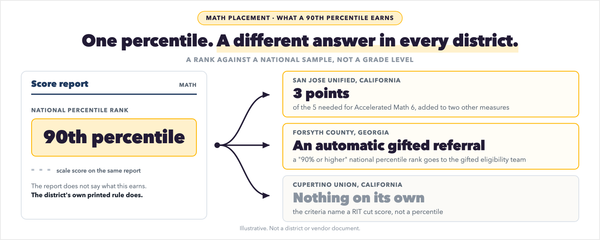
The printed scores. This is the column districts differ on most. Some print a cut score, the number a district prints as the bar. Cupertino Union prints numbers. An NWEA RIT of 235 or higher places a child in Math 7+, and 250 or higher places a child in Algebra 1 in 7th grade. The RIT is the score number MAP prints. MAP is a test many districts give three times a year, and NWEA makes it. NWEA's own family guide says what the number is and how often the test runs. Next to the RIT, Cupertino counts readiness-test percentages (scores on the district's own readiness test), semester grades and teacher verification. Plano ISD prints no number for its Math Rocks program: the district reads MAP scores and CogAT (a reasoning test) scores, takes no application, and emails invitations in early April. Write down the test's name, the number if there is one, and the words the district uses when there is no number ("mastery level", "minimum proficiency", "multiple measures").
The dates. Two dates matter: when the decision is made, and when a window closes. Frisco ISD prints the close to the minute: its gifted referral windows, which are a separate process from math placement, run January 5 to January 19, 2027 and close at 3:00 pm CST. Many districts print only a month. Write the month if that is all there is, and note that the month is a pattern, not a promise. If your child is in 5th grade now, the decision may be made this school year, so the afternoon belongs in the fall. San Jose Unified scores the grade 5 spring i-Ready, a diagnostic test given at school. Sunnyvale School District builds a 5th grade recommendation from a district benchmark and trimester 2 math grades. Its FAQ aims to send that recommendation in mid-February; in 2025 the letters went out in early April.
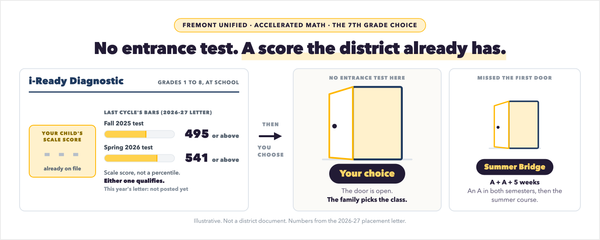
The second door. The route for a child who missed the first one. San Jose Unified opens a challenge assessment at exactly 4 points on its own three-measure table, and 5 or more points place a child in Accelerated Math 6 outright. Fremont Unified runs a Summer Bridge for a 7th grader who earned an A in both semesters of the grade-level course. Other districts print a review request, an appeal, or nothing at all. Nothing at all is a common answer, and it is worth knowing before the first door closes. Search the district's site for the words that name this door: appeal, challenge, acceleration, summer bridge, review and transfer.
Every district in the four columns above is a California or a Texas district. The state changes the names, not the four things any district has to decide. Every district decides which courses exist, what gets a child into the faster one, when that is decided, and what a child who missed it can still do. Where a rule says "the state test", read it as your own state's: CAASPP in California, STAAR in Texas.
Which pages to open
Three or four pages hold the four columns almost everywhere. Start with the mathematics or curriculum page under the district's academics or educational services menu; that is where the lanes and any printed criteria live. Next, the middle school transition FAQ, or the page for incoming 6th graders; that is where the test month and the notification date usually sit. Third, the student support or enrollment section; that is where acceleration processes, transfer rules and new-student routes hide. If there is a fourth page, it is a board policy or a downloadable letter. Use the site's own search for the words placement, accelerated, honors, appeal and acceleration.
Date your reading. A printed number can vanish between two visits. Evergreen's page carried a raw score of at least 32 on the 6th grade diagnostic on August 31, 2026 and did not carry it a month later. The page never printed what the test was scored out of. To read an older version of any page, paste the page's address into the Wayback Machine at web.archive.org.
Evergreen School District, page by page
Three pages gave everything below: the academics page, the middle school transition FAQ, and the K-8 acceleration process page.
| Column | What the district's pages say | Which page |
|---|---|---|
| The lanes | Every middle school offers Common Core Math 7 and Accelerated Math 7/8. The accelerated course is a compacted one that covers both 7th and 8th grade standards in 7th grade. In 8th grade, students in that course take a high school Math 1 equivalent, the first high school math course. | Academics page; transition FAQ |
| The printed scores | Three measures are named for automatic enrollment: exceeding 5th and 6th grade standards on the state test (CAASPP), minimum proficiency on a 6th grade diagnostic (the MDTP, the Mathematics Diagnostic Testing Project test, a readiness test many California districts give), and satisfactory grades. The list is not closed: the FAQ says placement takes into account a variety of factors, including but not limited to grades, standardized test scores and teacher evaluations. No cut score is printed as of September 30, 2026. Questions about the district's set criteria go to the Assistant Superintendent of Educational Services. | Academics page; transition FAQ |
| The dates | All 6th graders take the MDTP in May. Families learn the placement in August, when schedules post in PowerSchool, the district's online grade and schedule system, typically the day before school begins. | Transition FAQ |
| The second door | None for math. The only printed route is whole-grade acceleration, which means skipping a whole grade, not moving up a math lane. A signed letter to the principal starts it, physical copies only, or a teacher's recommendation does. Then comes a meeting within four weeks, and a 98th percentile in all areas of the tests the school psychologist gives. Summer programs do not qualify a student to skip a class. Parents may keep an eligible child in the traditional sequence. | Acceleration process page; transition FAQ; academics page |
Two columns are full and two are thin, and the thin ones are the useful part. In the archived versions, that missing number sat on the page unchanged from September 2023 through April 2025. The only printed second door is a whole-grade skip, not a way into the accelerated math course for a child who missed the May test. Both are answers a parent can act on.
What to do with a blank column
- Write the blank into the table as a blank, with the date you looked. That is the record you bring to the school.
- Ask the office the district's own page names. Evergreen's FAQ names the Assistant Superintendent of Educational Services for the set criteria; most districts name a counselor, a department head, or Academic Services. If no page names an office, send the email to your child's school counselor, or to the district's curriculum office.
- Ask three questions in one email: what score or grade the criteria use, when the decision is made and how it is sent, and what a child who missed the test or is new to the district can do this year.
- Look again before the test month. The test month is the one the dates column gave you. If that column came back blank, the second question in your email is the date. The lanes rarely change. The numbers and dates do.
If your district is one we have mapped, the reading is already done: Cupertino Union, Plano ISD, Frisco ISD, Fairfax County, and Cupertino, Sunnyvale and San Jose side by side. The fourteen-district check says whether a district gives a gifted test at all. For reading the score itself once you know which test counts, the MAP guide, the i-Ready guide and i-Ready vs MAP take it from there.
Where Cuemath fits
We do not set any district's rules, and we cannot move a cut score. What the four columns cannot tell you is how close your child already is to the number in them, and that is what decides whether the faster lane is worth trying for.
The table tells you the rule. It does not tell you where your child stands.
A free Cuemath MathFit evaluation is a live, one-on-one session that shows where your child is solid and where a gap sits, before the district's test month arrives.
Book a Free EvaluationFor students in Grades K to 12 worldwide.
FAQs
Are math placement rules the same in every district?
No. Each district sets its own courses, its own test, its own numbers and its own dates. Cupertino Union prints an NWEA RIT cut; San Jose Unified adds points from an i-Ready percentile; Evergreen names a diagnostic and prints no number at all. The four columns are the same everywhere. What fills them is not.
Where on a district website are the math placement rules?
On three or four pages, not one: the mathematics or curriculum page, the middle school transition FAQ, and the student support or enrollment section. A board policy or a downloadable letter is sometimes the fourth. If the site's own search for placement, accelerated, honors and appeal turns up nothing, ask the office the pages do name, or your child's school counselor, or the district's curriculum office.
What if the district names a test but prints no cut score?
Write that down as the answer, with the date. Evergreen names three things for automatic enrollment: the CAASPP, a 6th grade diagnostic, and satisfactory grades. As of September 30, 2026 it prints no number for any of them. Its FAQ sends questions about the set criteria to the Assistant Superintendent of Educational Services. Ask that office in writing what score or level the criteria use, and keep the reply.
What is a second door?
A route into the faster course for a child who did not get in the first time. Districts print several kinds, including a challenge test, a summer bridge course, a review request, and an appeal. Many districts print none. Evergreen prints only whole-grade acceleration, which is a different thing: a skip of an entire grade, with a 98th percentile requirement.
Does a summer math program get my child into the accelerated class?
Not on its own, in the fourteen districts this blog has read. Evergreen says in print that completing summer programs does not qualify a student to skip classes or be placed in advanced classes. Where a summer route into a middle school course exists, it is the district's own. Fremont's Summer Bridge takes a 7th grader who earned an A in both semesters of the grade-level course. A program outside the district is not one of those routes.
How do I know the page I am reading is current?
Look for a printed school year, a dated letter, or a window with a year in it, and note the date you read it. Numbers move without notice: Evergreen dropped its printed cut number between August 31 and September 30, 2026. If the page prints last year's dates, treat them as the pattern and confirm the new ones with the school before the test month.
When should I do this reading?
Before the test month, and in most districts that means the fall. Evergreen tests in May and tells families in August. Cupertino prints its spring window as March 9 to 20, with no year. Plano emails Math Rocks invitations in early April. Each district's dates are its own, so do the reading in the semester before the decision.