What Is MATHCOUNTS, and How Does a Child Get In?
MATHCOUNTS is a live math competition for students in grades 6-8, run by the MATHCOUNTS Foundation, and the school enters it, not the parent. A school registers up to 14 students, names a coach, and sends them to a local chapter competition in February 2027.

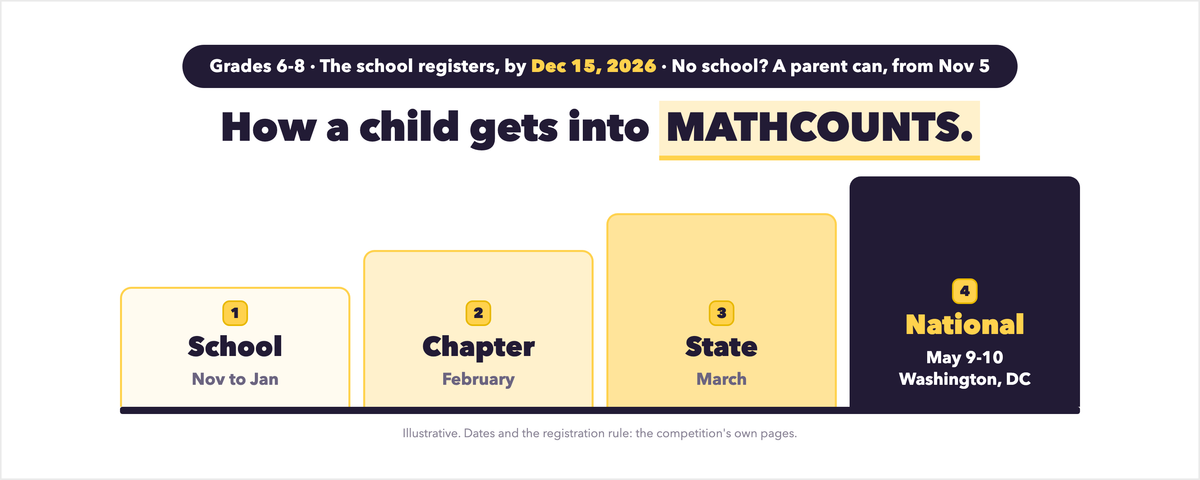
MATHCOUNTS is a live math competition for students in grades 6-8, run by the MATHCOUNTS Foundation, and the school enters it, not the parent. A school registers up to 14 students, names a coach, and sends them to a local chapter competition in February 2027. Winners climb to state in March and to the national final in Washington, DC, on May 9-10, 2027. Your one move is a question for the school: are we registered, and if not, will you register by December 15, 2026? That is the date the organizer guarantees a spot. If the school says no, there is a second door: from November 5, 2026, a parent can register the child directly as a non-school competitor.
The ladder: school, chapter, state, national
Four levels, the same four rounds at each, about three hours per competition.
- School (November 2026 to January 2027). The coach prepares students through the fall, then gives the School Competition, released to coaches on November 3, 2026. Any number of students can take it. The coach picks who goes to chapter, and does not have to pick on that score alone.
- Chapter (February 1-28, 2027). About 500 local competitions. A few chapters run on January 30, 2027; the organizer's search tool has the local date. A school sends up to 14 students: a team of 4, plus up to 10 competing individually. The winning team advances, and so do the 2 highest-ranking students not on it.
- State (March 1-31, 2027). One per state and territory. The 4 highest-ranked students, plus the winning team's coach, earn an all-expenses-paid trip to nationals.
- National (May 9-10, 2027). The RTX MATHCOUNTS National Competition in Washington, DC. The 224 state qualifiers form 4-person state teams and also compete individually for the National Champion title.
One registration fee covers the whole ladder; a student who advances pays nothing more.
What a competition day looks like
| Round | What happens | Calculator | Who takes it |
|---|---|---|---|
| Sprint | 30 problems in 40 minutes, 1 point each | No | Everyone |
| Target | 8 problems in 4 pairs, 6 minutes per pair, 2 points each | Yes | Everyone |
| Team | 10 problems in 20 minutes, solved together | Yes | The 4 team members only |
| Countdown | Oral, head-to-head, up to 45 seconds a problem | No | Top scorers; optional below national |
The Sprint and Target Rounds set a child's Individual Score. The organizer says 23 out of 46 is highly commendable.
Who registers, and how many students
A math teacher, principal, or other school official registers the school, names a coach, and pays. A parent volunteer can do the registering only with the administration's permission, which the organizer recommends getting in writing.
The cap is one team of 4 plus up to 10 individuals, so a school can send anywhere from 1 to 14 students to its chapter competition. Individuals skip the Team Round but can still win awards, reach the Countdown Round, and advance on their own score. Before chapter, the coach tells the local coordinator who is on the team and who competes individually.
Any type of school can register: public, private, religious, charter, virtual, or home school. A tutoring center or enrichment program cannot, because it is not the child's official school of record. A registered coach receives a School Competition Kit with the printed 2026-2027 MATHCOUNTS School Handbook.
The 2026-27 dates and fees
Registration opened August 17, 2026. The fee depends on when the school registers, and the organizer's critical dates page lists the registration deadlines:
- By November 3, 2026 (early bird): $42 per student for schools.
- By December 15, 2026 (regular): $48 per student for schools; $75 per non-school competitor.
- After December 15, 2026 (late): $53 per student for schools; $85 per non-school competitor.
December 15, 2026, is the date that matters. The organizer guarantees participation for registrations submitted by then. After that it says only this: many local coordinators accept late ones. Who pays follows who registers: the school pays the school fee, and a family pays the non-school competitor fee, $75 by December 15, 2026, and $85 after. Title I public and charter schools pay half.
The exact day and place of your chapter and state competition are set by volunteer coordinators. The organizer's competition search tool lists them, with the coordinator's contact details, as they are confirmed through the fall and winter.
If the school says no
If the child's official school of record will not register and will not support participation through the school, the parent can register the child as a non-school competitor. This route opens November 5, 2026, at the non-school rates above, online only, paid by credit card. The parent is the coach, and the child receives the same kit a school does.
Three limits to know. Non-school competitors compete as individuals only, never on a team. The organizer may check with the school and can cancel the registration without refund if the school registers later, so get the school's answer before you pay; non-school registrations are not refunded. And at most 14 non-school competitors may come from one school, first come, first served.
Homeschooling is a different case. A homeschooled child registers through the home school as a school, not as a non-school competitor, and the home school coach files the 2026-2027 Home School Participation Form by December 31, 2026.
The one conversation
Ask the math teacher, or whoever runs the school's math club, three things:
- Is the school registered this year? The organizer publishes a list of registered schools for 2026-2027, so you can check before you ask.
- If yes, who is the coach, and how does my child get onto the chapter roster? The coach can add students until the school reaches 14.
- If no, will the school register by December 15, 2026? A parent can do the paperwork with the administration's permission, ideally in writing. If the answer is still no, the non-school competitor route is yours from November 5, 2026.
Early matters because of what closes: a registration submitted by December 15, 2026, is guaranteed a place; the school's roster stops at a team of 4 plus up to 10 individuals, and the coach picks who fills it; and only 14 non-school competitors from one school can register, first come, first served.
Between now and February, the child needs problems that do not look like homework. The organizer posts last year's competitions free, and they are the closest thing to the real test. For the ideas underneath these problems, Cuemath's free math concept explanations go one idea at a time, no clock.
The AMC 8 and MOEMS are also entered by the school. MATHCOUNTS is the one with a ladder. It also publishes a direct-entry route for a child whose school does not register; MOEMS lists individual entry with restrictions it does not spell out.
Where Cuemath fits
We do not run MATHCOUNTS and we cannot register your child for it. Registration is the school's, or, if the school refuses, yours through the organizer's site.
What the competition rewards is reasoning on multi-step problems a child has not seen before, on a clock. A free Cuemath MathFit evaluation is a live, 55-minute, one-on-one session that shows where your child's math reasoning stands and where a gap sits.
Know where your child's math reasoning stands
A free Cuemath MathFit evaluation is a live, 55-minute, one-on-one session. It cannot enter your child in MATHCOUNTS. It shows where your child's math reasoning stands and where a gap sits.
Book a Free EvaluationFor students in Grades K to 12.
FAQs
Can I register my child for MATHCOUNTS myself?
Only if your child's official school of record is not registering for the Competition Series and will not support participation in the program through the school. Both must be true. If your school meets both, you register from November 5, 2026, online by credit card, $75 by December 15, 2026, and $85 after. Confirm the school's refusal first: the organizer may check with the school and can cancel a non-school registration without refund if the school registers later.
What grades can compete in MATHCOUNTS?
Grades 6, 7, and 8 only, and the child must be enrolled full-time in those grades; taking a middle school math class is not enough. Each student can compete for at most three years, so a grade 6 entry uses one of the three. There is no limit on the years a student can take part in school-based coaching.
How much does MATHCOUNTS cost?
For schools, $42 per student by November 3, 2026, $48 by December 15, 2026, and $53 after. For a non-school competitor, $75 by December 15, 2026, and $85 after. One fee covers chapter, state, and national; nothing more is charged to advance. Title I public and charter schools pay half, and a school that cancels can ask for its fee back minus $50, with nothing processed after February 1, 2027.
When are the 2027 MATHCOUNTS competitions?
School competitions run November 2026 to January 2027 on a date the coach picks. Chapter competitions are February 1-28, 2027, on the organizer's calendar, though its own search list already shows a few chapters on January 30, 2027. State competitions are March 1-31, 2027. The national competition is May 9-10, 2027, in Washington, DC. Your chapter's exact day is set by the local coordinator and appears in the organizer's competition search tool as it is confirmed.
How many students advance from chapter to state?
At least 6 per chapter when the winning team has 4 members: that team, plus the 2 highest-ranking students not on it, whether they registered as individuals or on another team. A state coordinator may advance more, as long as the same rule applies to every chapter in the state. From state, the 4 highest-ranked students and the winning team's coach go to nationals.
Can homeschooled kids do MATHCOUNTS?
Yes, as a home school, not as a non-school competitor. The home school or home school group registers like a school, the parent can be the coach, and the coach files the 2026-2027 Home School Participation Form by December 31, 2026. The home school must comply with its state's homeschooling law.
Does my child need a calculator?
For two of the four rounds. The Sprint Round and the Countdown Round are done without one. The Target Round and the Team Round assume a calculator. The organizer does not grant a calculator in those rounds or extra time in any round; other accommodation requests go to the chapter or state coordinator in writing at least three weeks ahead.
What is a good MATHCOUNTS score?
The organizer calls an Individual Score of 23 out of 46 highly commendable, and says its scores do not follow normal grading scales. The score is 1 point for each correct Sprint problem and 2 points for each correct Target problem: 30 Sprint problems and 8 Target problems, so 46 at most. Where a chapter runs an official Countdown Round, the top 25% of students, up to 10, qualify for it.