Kindergarten Math: What Your Child Should Know by June
By the end of kindergarten, the published standards expect a child to count to 100 by ones and by tens, count out up to 20 objects, and write the numbers 0 to 20. The list is short, and most of it is number.

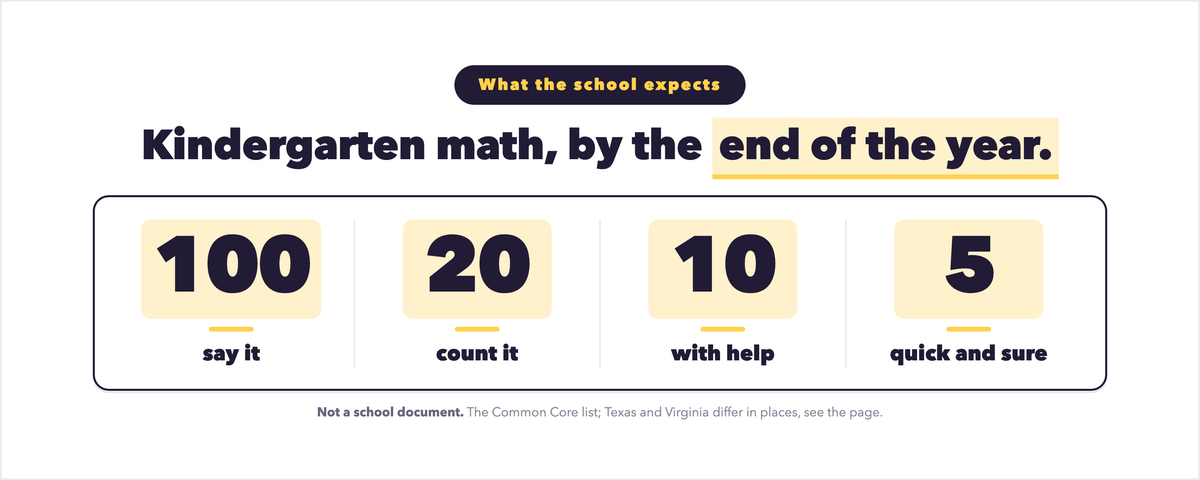
By the end of kindergarten, the published standards expect a child to count to 100 by ones and by tens, count out up to 20 objects, and write the numbers 0 to 20. They expect the child to say which of two small groups has more, add and subtract within 10 using objects or drawings, and add and subtract within 5 fluently. The list also asks the child to see a teen number as ten and some ones, name flat and solid shapes whichever way they are turned, and sort objects and count each pile. Those are the main items. The list is short, and most of it is number: the standards say more kindergarten learning time should go to number than to other topics. These are the Common Core standards, which 41 states have adopted, by the count on the standards' website. Texas and Virginia publish their own lists (both are in the table below), and nine states in all have not adopted the Common Core; the standards site's state lookup page shows which applies to you, and your child's teacher can name the document the report card follows. Those two lists overlap with this one at most points.
The list, by the end of the year
The Common Core groups kindergarten math under five headings. The codes are the standard numbers, so you can find the exact line a teacher is using.
- Counting (K.CC). Say the numbers to 100 by ones and by tens (K.CC.A.1), and start counting from a number other than 1 (K.CC.A.2). Write the numbers 0 to 20 and match a written number to that many objects (K.CC.A.3). Count objects one at a time, and know the last number said is how many (K.CC.B.4). Count a set of up to 20 objects in a line, a grid or a circle, or up to 10 scattered, and count out a given number of objects (K.CC.B.5). Say whether one group of up to 10 has more, fewer or the same as another (K.CC.C.6), and compare two written numbers between 1 and 10 (K.CC.C.7).
- Adding and subtracting (K.OA). Show adding and taking away with objects, fingers, drawings, sounds or acting it out (K.OA.A.1). Solve word problems within 10 using objects or drawings (K.OA.A.2). Break a number up to 10 into pairs in more than one way, such as 5 = 2 + 3 and 5 = 4 + 1 (K.OA.A.3). For any number from 1 to 9, find what makes 10 (K.OA.A.4). Add and subtract within 5 fluently (K.OA.A.5).
- Teen numbers (K.NBT). See 11 to 19 as ten ones and some more ones, such as 18 = 10 + 8 (K.NBT.A.1).
- Measuring and sorting (K.MD). Say what can be measured about an object, such as length or weight (K.MD.A.1), and put two objects side by side to say which is taller, longer or heavier (K.MD.A.2). Sort objects into groups, count each group, and order the groups by count (K.MD.B.3).
- Shapes (K.G). Name squares, circles, triangles, rectangles, hexagons, cubes, cones, cylinders and spheres, whichever way they are turned and whatever their size (K.G.A.2), and say whether a shape is flat or solid (K.G.A.3). Describe where things are with above, below, beside, in front of, behind and next to (K.G.A.1). Compare shapes by their sides and corners (K.G.B.4), build and draw them (K.G.B.5), and put small shapes together to make bigger ones (K.G.B.6).
Writing equations is not on the list. The standards say kindergarteners should see addition and subtraction equations, and that writing them "is encouraged, but it is not required."
The four numbers that matter: 100, 20, 10 and 5
Parents hear "count to 100" and picture a child counting a hundred things. The Common Core sets different ceilings for different skills, and mixing them up is the most common way to misread a five-year-old.
- 100 is for saying the numbers. K.CC.A.1 asks a child to count to 100 by ones and by tens. It is the sequence, out loud. No objects.
- 20 is for counting things. The largest set a kindergartener is asked to count is 20 objects in a line, a grid or a circle, or 10 objects scattered (K.CC.B.5). Writing numbers also stops at 20.
- 10 is for adding and subtracting with help. Word problems and sums stay within 10, and the standard allows "objects or drawings to represent the problem" (K.OA.A.2). Comparing groups also stops at 10.
- 5 is the number the standards ask for fluency on: quick and sure. The only Common Core kindergarten standard that uses the word fluently is K.OA.A.5: "Fluently add and subtract within 5." Fluency within 10 is a first-grade standard (1.OA.C.6).
A child who can rattle off the numbers to 100 but loses count at 14 objects is not ahead in counting; the second skill is the harder one at five. And a child who still uses fingers for 7 + 2 in the spring is exactly where the kindergarten standard puts them.
Where Texas and Virginia differ
Texas and Virginia publish their own kindergarten math standards: the Texas Essential Knowledge and Skills, and Virginia's 2023 Standards of Learning. Both cover most of the same ground as the Common Core list. Most of the differences are at the edges, and a few of them matter for what a report card asks.
| Skill | Common Core | Texas (TEKS 111.2) | Virginia (2023 SOL) |
|---|---|---|---|
| Count out loud | to 100 by ones and by tens | to at least 100 by ones and tens, starting from any given number (111.2(b)(5)); forward and backward to at least 20 (111.2(b)(2)(A)) | to 100 by ones, and on from any number within 100; backward from any number 1 to 20 (K.NS.1) |
| Read and write numerals | 0 to 20 | 0 to at least 20 (111.2(b)(2)(B)) | 0 to 30 (K.NS.2) |
| Count a set of objects | up to 20 (10 if scattered) | up to at least 20 (111.2(b)(2)(C)) | up to 30 one by one; up to 100 grouped in tens (K.NS.1) |
| Add and subtract | within 10 with objects or drawings; within 5 fluently | sums up to 10 and differences within 10, with objects and drawings (111.2(b)(3)(B)) | within 10; breaking a number up to 5 into two parts "with fluency" (K.CE.1) |
| Teen numbers as ten and ones | yes, 11 to 19 | not in the kindergarten list | yes, 11 to 19 (K.NS.1) |
| Shapes | squares, circles, triangles, rectangles, hexagons; cubes, cones, cylinders, spheres | circles, triangles, rectangles and squares "as special rectangles" (111.2(b)(6)(A)); cylinders, cones, spheres, cubes (111.2(b)(6)(B)) | circles, triangles, squares, rectangles (K.MG.2) |
| Measuring by comparison | length or weight, as examples | length, capacity, weight (111.2(b)(7)(A)) | length, height, weight, volume, time (K.MG.1) |
| Also on the list | no coins, calendar or patterns | recognize small quantities instantly (111.2(b)(2)(D)); U.S. coins by name (111.2(b)(4)); ways to earn income, wants and needs (111.2(b)(9)); real-object and picture graphs (111.2(b)(8)) | repeating patterns (K.PFA.1); the days of the week and the months of the year (K.MG.3); object and picture graphs (K.PS.1) |
Texas parents: the TEKS list adds counting backward to at least 20, naming U.S. coins, and telling wants from needs, and it has no teen-numbers line. Virginia parents: the Standards of Learning add repeating patterns, the days of the week and the months of the year, and a comparison of how long two events take, and they ask for counting sets of up to 30 objects one by one.
Every cell comes from the published standards document itself, checked on September 28, 2026; the last row lists the extras parents ask about, not every line.
Reading a report card against the list
If your child's report card uses words instead of the codes, one word can cover several standards. If a line reads as "not yet met," ask the teacher which standard it is; the answer decides what you do at home.
Two other things sometimes arrive in a kindergarten year, and neither is on this list. A short check the district gives reports against grade-level skills; ask which areas it covered, because a check that only looks at counting has not seen the shape or sorting work. An ability test such as the CogAT, which a district may give as early as kindergarten, measures reasoning rather than these skills; see our CogAT by grade page. And if you want practice rather than the list, the 40-question kindergarten practice page on this blog is built on the same standards.
What behind and ahead mean at five
The standards document is written by grade. Each kindergarten line is what a child should be able to do by the time the year ends, not by the first report card. A child who cannot do most of the list in October is not behind.
In September or October the question is not the list; it is whether the number work has started: counting objects with one touch per number, comparing two small groups, and joining and separating small sets.
Behind means an area that is still not there as the year closes. Since number is most of the list, look there first, and at the specific standard rather than the heading: a child can compare two groups of five and still not count out 17 objects. If a number skill is not landing after months of school, the useful question is which piece is missing, and our page on what is actually missing gives the three usual answers. Those three are a missing building block from an earlier year, fluency that is not there yet, or shaken confidence.
The list tops out at adding within 10 and counting to 100, so ahead in kindergarten mostly means solid on those. Past that, a child is working on first-grade standards, counting to 120 (1.NBT.A.1) and adding within 20 (1.OA.C.6). That is a fact about the child, not a placement; the school's own report is the one that counts.
See which of these your child already has
A free Cuemath MathFit evaluation is a live, one-on-one session, for kindergarteners and up. It is not a school readiness test and it does not change a school placement. It shows which of these skills your child already has and which are still forming, so you know where to spend the time at home.
Book a Free EvaluationFor students in Grades K to 12.
FAQs
What do "compose" and "decompose" mean on a kindergarten report card?
Putting a number together from parts and breaking it into parts: 5 as 2 and 3, or 18 as 10 and 8. The Common Core kindergarten number standards use these words in two places, for numbers up to 10 (K.OA.A.3) and for the teen numbers 11 to 19 (K.NBT.A.1). It also uses "compose" for shapes (K.G.B.6). Objects and drawings count; a written equation is optional.
Is counting to 100 the same as counting 100 objects?
No. Counting to 100 is saying the number words in order, by ones and by tens. Counting objects stops at 20 in the Common Core list and at 30 in Virginia's, where a child also groups up to 100 objects into tens. The test is touching each object once while saying one number, then knowing that the last number said is the total.
What does "fluently add and subtract within 5" mean?
It is the one place the Common Core kindergarten list uses the word fluently, and it covers only sums and differences up to 5. Everything within 10 may still be done with objects or drawings. Fluency within 10 arrives in first grade, where the standard also extends adding and subtracting to 20.
Which shapes should a kindergartener know?
In Common Core states: squares, circles, triangles, rectangles and hexagons, plus cubes, cones, cylinders and spheres, named correctly however they are turned. Texas lists circles, triangles, rectangles and squares, calling squares "special rectangles," plus cylinders, cones, spheres and cubes. Virginia's kindergarten list stops at circles, triangles, squares and rectangles.
Does kindergarten math include money, time or patterns?
It depends on the state. The Common Core kindergarten list has none of the three. Texas asks kindergarteners to name U.S. coins and to tell wants from needs. Virginia asks for repeating patterns, the days of the week and the months of the year, and a comparison of how long two events take.
How do I know which list my child's school uses?
Ask the teacher which standards document the report card follows; the document is public and every line on it has a code. Texas schools follow the TEKS and Virginia schools follow the Standards of Learning. By the count on the standards' website, 41 states adopted the Common Core, and the same page notes that states review the standards and may change or add to them, so the local version can differ in places from the list on this page.
My child is in kindergarten in October and cannot do most of this. Is that behind?
No. The list is written for the whole grade, so it describes the end of the year, not October. In the fall the question is whether the number work has started; the section on what behind and ahead mean at five lists what to look for.
What comes next, in first grade?
Counting to 120 from any starting number, reading and writing numerals in that range, and adding and subtracting within 20 with fluency within 10. Those are the first-grade Common Core standards, and they are where a kindergartener who has finished this list is heading.