What Math Does an All-in-One Homeschool Curriculum Include?
Every all-in-one homeschool curriculum ships with a math course already inside, and across the seven programs on this page that course is one of two kinds. None of these boxes places a child against the grade standards a school would use.

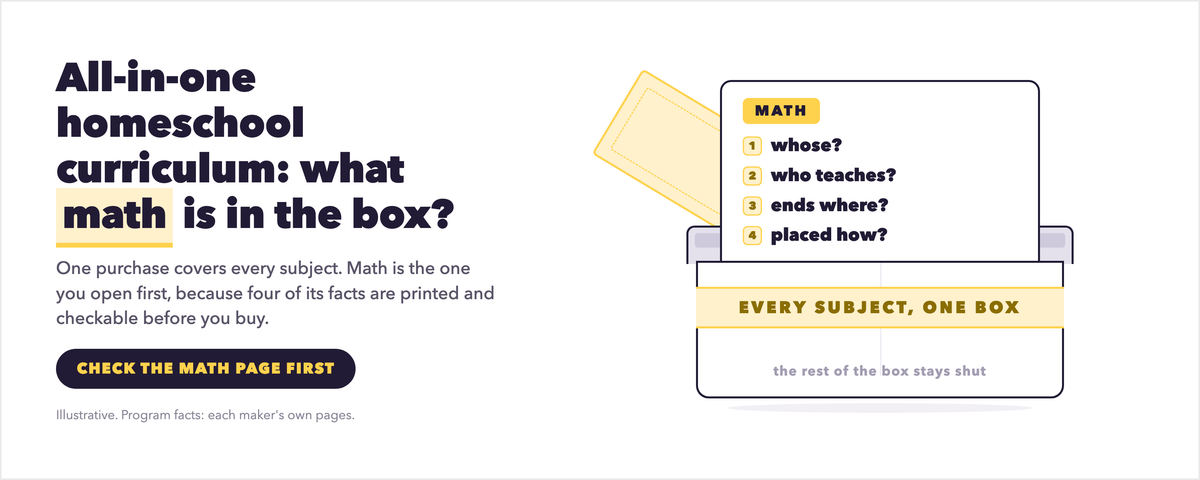
Every all-in-one homeschool curriculum ships with a math course already inside, and across the seven programs on this page that course is one of two kinds. Five of them wrote their own math: Time4Learning, Power Homeschool, Miacademy, Abeka, and The Good and the Beautiful. Two package another maker's math next to their own reading and history: Sonlight and BookShark sell programs such as Math-U-See, Saxon, Singapore Math and RightStart in the box. None of these boxes places a child against the grade standards a school would use. Each one works inside its own sequence: where a box has a placement test, it tells you which of its own levels to buy, not how far the child is from grade level; where it has none, you pick the grade yourself. There are four things you can check on the maker's math page before you buy: whose math it is, who teaches the lesson (a video teacher, a self-paced program, or you with a manual), where the math ends (two of the seven stop at grade 8), and how a child is placed (a PDF test, a free assessment, or a grade level you set yourself). Read that math page before the box's homepage. The math is the part of a box you can swap for a separate program without giving up the rest, so it is the part to judge first.
This page covers the math in each box only: no prices, no ranking, and nothing on the other subjects. Prices and formats change; each maker's own page has today's.
Two kinds of box
The maker's own math. Time4Learning, Power Homeschool (which sells Acellus courses), Miacademy, Abeka (its Arithmetic/Mathematics line), and The Good and the Beautiful (Simply Good and Beautiful Math) each wrote the math in its own box. What that math is like, where it ends and how it places a child are the maker's own decisions, and the next three sections read them off the makers' pages.
Someone else's math in the box. Sonlight's math page offers a choice of programs including Math-U-See, Horizons Math, Singapore Math, Saxon Math, Miquon Math and RightStart Math, and tells you to compare them on its chart and pick one. BookShark's math shop sells packages under Math-U-See, Singapore Math (including Primary and Dimensions), RightStart and Saxon. With these two, the math in your box is the same program you could buy on its own, with that program's placement tool and endpoint. The four checks for choosing that program apply to it directly.
Who teaches the lesson
Time4Learning and Power Homeschool put a screen in front of the child. Time4Learning teaches through animated lessons, instructional videos, quizzes and tests, and printable worksheets, at the student's own pace. Power Homeschool runs on filmed video lessons, with the student working at their own pace under the parent's supervision, and it describes two mechanisms of its own: Prism Diagnostics, which identifies a specific gap in a student's understanding and responds with instruction videos for that gap, and Vectored Instruction, which fills missing prerequisite skills while keeping the student inside the current course. Miacademy's lessons are videos with interactive practice and assessments, at a pace the parent can adjust.
Abeka gives you the choice on the same books. You can lead the lessons yourself with its lesson plans and textbooks, or hand the teaching to Abeka Academy's video lessons, on DVD or streaming video, with a video manual per course that tells you what to do and in what order. The Good and the Beautiful writes for a parent at the table: its math courses are open-and-go and need no daily prep time, and the maker describes the parent learning and exploring along with the child. No maker page we read prints minutes per lesson.
For Sonlight and BookShark, the teacher is whoever the packaged program assumes. How many of your hours a program expects is the second of the four checks on our page about choosing a math curriculum, and it applies to a box's math unchanged.
For the topics these courses teach, grade by grade, Cuemath's free math concept explanations go one idea at a time.
Where the math ends
Two of the seven stop before high school. The Good and the Beautiful says that Pre-Algebra (Math 8) is its highest level and that no higher levels will be offered. It publishes a High School Math Tracks chart for planning the years after. Miacademy is a K-8 curriculum; it continues into high school through MiaPrep, a separate program for grades 7 to 12. The other three own-math boxes run through 12th grade: Time4Learning and Power Homeschool both state PreK through 12, and Abeka's high-school plan of study counts four math credits, including Algebra 1 and Plane Geometry. For Sonlight and BookShark, the endpoint is the packaged program's; Sonlight's page lists Math-U-See as K through 12th grade and Horizons Math as K through 6th.
If your box stops at grade 8, the handoff is a decision you make now, not in four years. The page on what comes after a program ends maps where thirteen standalone programs end and what their makers say comes next.
How each one places a child
Three of the seven publish a math placement tool. The Good and the Beautiful has a Math Placement Test for Math K through Pre-Algebra (Math 8), and says on the same page that its math "aligns closely with standard grade levels and is not considered an advanced curriculum." Sonlight offers a free math assessment and tells you to use it before you buy, to find the child's level in each program. On its own placement page, BookShark publishes the free placement tests of the four programs it sells, and says to take at least one before choosing math materials.
The rest place by grade, with you adjusting. Time4Learning lets you set a different grade level for each subject and change it at any time. Power Homeschool suggests courses based on the student's age or grade level, lets you adjust them, and starts every student at the beginning of each course; its diagnostics work inside the course from there. Miacademy designs its courses largely in alignment with typical national standards for each grade level and lets the parent set the pace. Abeka sells by grade, K4 through 12. None of these four names a math placement test on the pages we read. These absences were checked on September 28, 2026.
Each of the seven works inside its own sequence, not against the grade standards a school would use.
The seven boxes side by side
| Program | Whose math | How a lesson is delivered | Grades | Placement | Format |
|---|---|---|---|---|---|
| Time4Learning | Its own | Animated lessons, instructional videos, quizzes and tests, printable worksheets; student-paced | PreK-12 | Parent sets the grade level per subject, changeable any time; no placement test named | Online subscription |
| Power Homeschool | Its own (Acellus courses) | Filmed video lessons; diagnostics respond inside the course | PreK-12 | Courses suggested by age or grade, adjustable; every student starts at the beginning of a course; no placement test named | Online |
| Miacademy | Its own | Videos, interactive practice, assessments; pace set by the parent | K-8, with MiaPrep for 7-12 | Grade-level courses; no placement test named | Online subscription |
| Abeka | Its own (Arithmetic/Mathematics) | Parent-led with lesson plans, or Abeka Academy video lessons on DVD or streaming | K4-12 | Sold by grade; no math placement test named | Books, or video on DVD or streaming |
| The Good and the Beautiful | Its own (Simply Good and Beautiful Math) | Open-and-go lessons with the parent alongside; spiral | Math K to Pre-Algebra (Math 8) | Math Placement Test (PDF) | Not stated on the pages read |
| Sonlight | Packaged, including Math-U-See, Horizons, Singapore Math, Saxon, Miquon, RightStart | The packaged program's | The packaged program's (its page lists Math-U-See K-12, Horizons K-6) | Free math assessment before purchase | Not stated on the pages read |
| BookShark | Packaged, including Math-U-See, Singapore Math (Primary, Dimensions), RightStart, Saxon | The packaged program's | The packaged program's | Free placement tests for the four programs, on BookShark's own placement page | The packaged program's |
Every cell comes from the maker's own pages, read on September 28, 2026. Where a page states nothing for a cell, the cell says so.
Reading a box's math page in ten minutes
- Open the math page, not the homepage. Find whose math it is: the maker's own course, or a named outside program.
- Find who teaches: a video teacher, a self-paced screen, or you with a manual. Match it to the hours you actually have.
- Find the last course. If the math stops before high school, write the handoff year on your calendar now.
- Find the placement step. Run the test or assessment before you buy a full year. If there is none, you are choosing the grade yourself.
- Decide the shape: the box as sold, or the box minus its math plus a separate math program. Choosing that program has its own page.
A placement test tells you which level of one program to buy. A free Cuemath MathFit evaluation measures where your child's math stands overall, and what happens in the session is on its own page.
Know where your child's math stands before you pick the box
A free Cuemath MathFit evaluation is a live, one-on-one session that shows where your child's math actually is, so you can place them into the box's math, or a separate program, from where they are.
Book a Free EvaluationFor students in Grades K to 12.
FAQs
Is the math in an all-in-one homeschool curriculum the same as a standalone math program?
Sometimes. In Sonlight and BookShark boxes, it is the standalone program itself: the same Math-U-See, Saxon, Singapore Math or RightStart levels those makers sell on their own. In Time4Learning, Power Homeschool, Miacademy, Abeka and The Good and the Beautiful, it is the maker's own math course, so its lesson shape, endpoint and placement are that maker's, not a math publisher's.
Can I buy an all-in-one curriculum and use a different math program?
Yes. In each program here the math is its own course or its own package, so you can leave it aside and run another spine (the one math program a homeschool builds the year on), even where a bundled subscription still includes it in the price. Time4Learning sets each subject's level separately, Power Homeschool lets parents add or remove courses, Abeka sells single-subject kits, and Sonlight and BookShark sell math packages on their own math pages. How to choose that separate spine is on our page about choosing a math curriculum, linked above.
Which all-in-one programs stop math before high school?
The Good and the Beautiful and Miacademy. The Good and the Beautiful's highest level is Pre-Algebra (Math 8), and the maker says no higher levels will be offered. Miacademy runs K-8 and continues into grades 7 to 12 through MiaPrep, a separate program. Time4Learning, Power Homeschool and Abeka list math through 12th grade.
Do all-in-one programs have math placement tests?
Three of the seven do. The Good and the Beautiful publishes a Math Placement Test PDF for Math K through Pre-Algebra (Math 8). Sonlight offers one free math assessment that gives the child's level in each program it sells. On its own placement page, BookShark publishes the free placement tests of the four programs it sells, and says to take at least one before choosing math materials. As of September 28, 2026, the pages we read for Time4Learning, Power Homeschool, Miacademy and Abeka name no math placement test; the first two place by grade or age with the parent adjusting.
Does the box's math follow Common Core or state standards?
Four of the makers say something about it. Time4Learning says its math program correlates to all state standards. Miacademy says it designs its courses largely in alignment with typical national standards for each grade level, considering state standards including Common Core, without adhering strictly to one set. The Good and the Beautiful says its math aligns closely with standard grade levels. Power Homeschool says its course materials are standards-based, without naming a set of standards. Abeka, Sonlight and BookShark do not state a standards alignment for math on the pages we read.
What does "spiral" mean on Abeka's and The Good and the Beautiful's pages?
Concepts come back through the year rather than being finished one at a time. The Good and the Beautiful defines it on its placement page: its math "continually reviews previously learned concepts to reinforce understanding and retention." Abeka calls its approach a "spiral learning approach" and does not define it on the pages we read. The other shape, one topic at a time until it is mastered, is explained on that same page.
My child is behind in math. Which boxes let them work below grade?
Five of the seven answer this on their own pages. Time4Learning lets the parent set a different grade level for each subject and change it at any time, so math can sit below the child's other subjects. Power Homeschool starts every student at the beginning of each course, and parents can add or remove courses at any time, so a lower course is yours to pick. The Good and the Beautiful places by its own test rather than by the child's grade. Sonlight and BookShark point you at the packaged program's own placement test, which gives the child's level in that program. For Miacademy and Abeka, the pages we read say nothing about placing a child below their grade.
My child is ahead in math. Which boxes let them work above grade?
The ones that place by grade, if you set the level. Time4Learning lets you set math at a different grade level from the child's other subjects and change it at any time. Power Homeschool says a student who understands the video lessons well is helped to advance in the subjects where that happens, math included. The Good and the Beautiful places by its test, says its math is "not considered an advanced curriculum," and ends at Math 8, so a child working ahead reaches the end sooner. Check the last course before the first one.
Does Time4Learning's math include math-facts practice?
Yes. Time4MathFacts is built into Time4Learning at no extra cost to members, and the maker describes it as designed for students in grades 2 to 4. It sits alongside the main math course rather than replacing it.