Ohio's New Advanced Math Law: How 3rd Grade Scores Decide 4th Grade Placement
Ohio's new advanced math law places students who score Advanced on the state math test in advanced math the next year, starting in Grade 4, so spring 2027 scores decide 2027–28 placement. Here's who qualifies, what advanced math means in each grade, the key dates, and how parents can opt out.

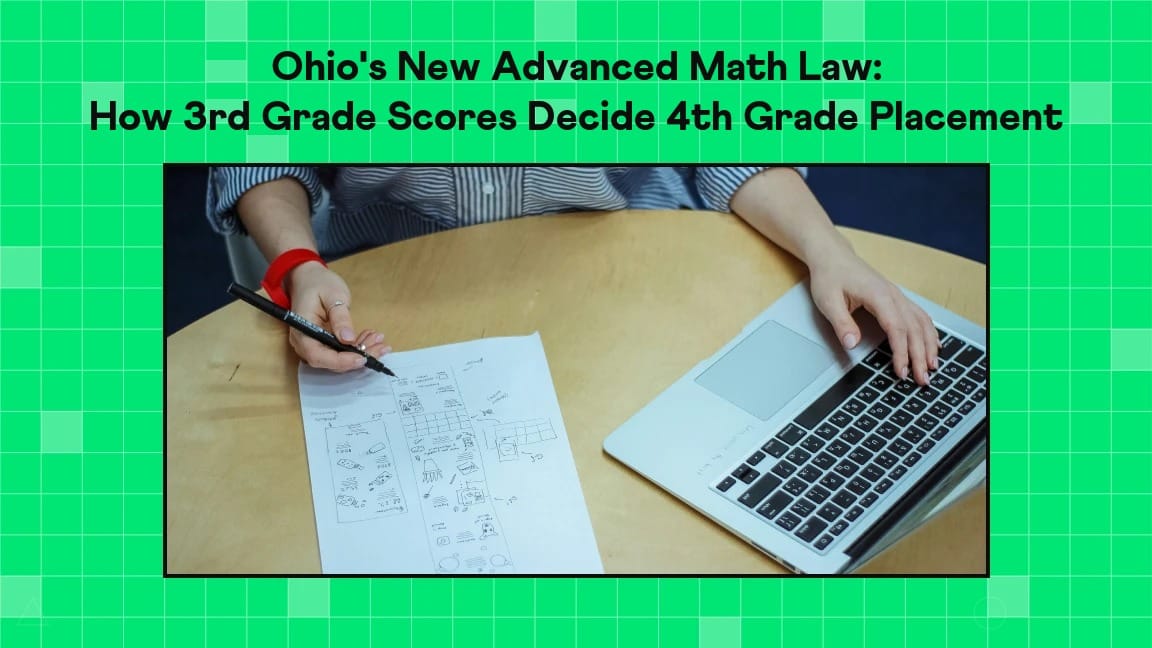
Under Ohio's new advanced math law, Senate Bill 19 (SB 19), students who score Advanced on the state math test are placed in advanced math the next year automatically, starting in Grade 4. So a 3rd grader's spring 2027 score decides whether they start 4th grade in advanced math in 2027–28. Parents can opt out.
SB 19 became law on June 24, 2026, and took effect on September 23, 2026. This blog explains how the 3rd grade score decides 4th grade placement, who qualifies, what advanced math means in each grade, the key dates, and how to opt out.
Key Takeaways
- A 3rd grader's spring 2027 Ohio State Test score in math decides whether they get advanced math in 4th grade (2027–28).
- Students who score Advanced on the Ohio State Test in math are placed in advanced math the next school year.
- Students who score Accomplished also qualify if they have an A or B in math or a qualifying score on a state-approved diagnostic test.
- Qualifying 6th graders move to a Grade 7 course that covers Grade 7 and Grade 8 math in one year, which leads to Algebra I in Grade 8.
- Schools must tell parents, and parents can opt out in writing.
- What Is Ohio Senate Bill 19?
- How Do 3rd Grade Scores Decide 4th Grade Placement?
- Who Qualifies for Advanced Math Under Ohio SB 19?
- What Advanced Math Looks Like From Grade 4 to Grade 8
- When Does Advanced Math Placement Start?
- Can Parents Opt Out of Advanced Math?
- How Many Ohio Students Could Qualify?
- How to Prepare Your Child for the Spring 2027 Ohio State Test
- Frequently Asked Questions
- Sources
What Is Ohio Senate Bill 19?
Ohio Senate Bill 19 (SB 19) is a 2026 state law that changes how Ohio schools teach math and help students who are behind or ahead. Governor Mike DeWine signed it on June 24, 2026, and it took effect on September 23, 2026. Its main parts are:
- Advanced math placement for students who score high on state math tests. This blog covers this part.
- Free tutoring and other help for students who score Limited, the lowest level, in math or English.
- Math improvement plans for schools where 51% or fewer of 3rd graders score proficient on the state math test.
- A math test for new teachers of pre-K to Grade 8. Those who don't pass can't be assigned to teach math until they do.
Ohio is one of many states that changed its math laws recently. Our blog on new state math laws covers the others.
How Do 3rd Grade Scores Decide 4th Grade Placement?
Ohio's first state math test is in Grade 3, so the Grade 3 score is the first one that can place a child in advanced math. Under SB 19, the spring 2027 test is the first that counts. Here's how it works for a child in 3rd grade this school year:
From the Grade 3 Test to 4th Grade Math
| When | What happens |
|---|---|
| 2026–27 school year | Your child is in 3rd grade |
| By December 22, 2026 | Your school board adopts its math placement and promotion policy |
| Spring 2027 | Your child takes the Grade 3 Ohio State Test in math |
| After results | If your child scored Advanced, or Accomplished plus the extra measure, the school must tell you. You can opt out in writing. |
| 2027–28 school year | Your child starts 4th grade with advanced math: a math course above grade level, or harder work in class |
The same rule applies every year after. A 4th grader's score decides 5th grade placement, and so on. A child who doesn't qualify in Grade 3 can still qualify with a higher score in Grade 4.
Who Qualifies for Advanced Math Under Ohio SB 19?
Under Ohio SB 19, a student qualifies for advanced math based on their Ohio State Test score in math. The Ohio State Test has five levels: Limited, Basic, Proficient, Accomplished, and Advanced. Only the top two can qualify:
Ohio State Test Math Score and What Happens Next Year
| Score level | Does the student qualify? |
|---|---|
| Advanced | Yes, automatically. The student is placed in advanced math the next school year. |
| Accomplished | Yes, if the student also has an A or B in math class, or a qualifying score on a state-approved diagnostic test. The district picks which of these it uses. |
| Proficient, Basic, or Limited | Not automatically. The school can still move the student up if it chooses. |
Schools can advance any student at their discretion, even without a qualifying score. So if your child scored Proficient but finds class math easy, ask the school about it.
What Advanced Math Looks Like From Grade 4 to Grade 8
Advanced math under SB 19 covers Grades 4 to 8 and means different things in different grades. In Grades 4 to 6 it means extra challenge. After Grade 6, it puts students on a fixed track to Algebra I in Grade 8.
Advanced Math Under Ohio SB 19, by Grade
| Grade | What a qualifying student gets |
|---|---|
| Grades 4 to 6 | "Advanced learning opportunities": a math course above their grade level, or harder work and other changes in their class |
| Grade 7 | 6th graders who qualify move to a Grade 7 course that covers Grade 7 and Grade 8 math in one year. The school can't offer only extra work in class instead. |
| End of Grade 7 | Students in that combined course take the Grade 8 state math test. A score of Proficient or higher places them in Algebra I. |
| Grade 8 | Algebra I, a high school course, taken in 8th grade |
The goal is for every high-scoring student to finish Algebra I by the end of 8th grade. In 2024, only 20% of Ohio students did.
For what a combined Grade 7 and 8 course is like, see the accelerated math section in our blog on the 6th grade math tutor. And our algebra tutor blog explains what Algebra I covers.
When Does Advanced Math Placement Start?
Advanced math placement under Ohio SB 19 starts in the 2027–28 school year. It uses scores from the spring 2027 Ohio State Tests. Here are the dates:
Ohio SB 19 Key Dates for Advanced Math
| Date | What happens |
|---|---|
| June 24, 2026 | Governor DeWine signs SB 19 |
| September 23, 2026 | SB 19 takes effect |
| December 22, 2026 | Deadline for each school board to adopt a math placement and promotion policy (90 days after the law took effect) |
| Spring 2027 | Students take the Ohio State Tests in math. These are the first scores that count. |
| 2027–28 school year | First students are placed in advanced math |
Your district's placement policy is due by December 22, 2026. Once it's out, it should say how the school will use test scores, grades, and diagnostic tests. Ask your school for a copy.
Can Parents Opt Out of Advanced Math?
Yes, parents can opt out of advanced math under Ohio SB 19. The school must tell you when your child qualifies, and you can opt your child out by sending the school a written notice.
Reasons parents opt out include a child who scored high but is stressed in math class, or a child who has a gap the test didn't catch. The sources don't give a statewide deadline for opting out, so ask your school when it needs your note.
How Many Ohio Students Could Qualify?
About half of Ohio's 3rd and 4th graders would likely score high enough to qualify, according to the Fordham Institute's estimate from 2025–26 state test results. By 6th grade, only about one in three may qualify.
In 2024–25, 55% of Ohio students scored Proficient or higher in math. The lowest level is common too: from 23% of 4th graders to 39% of 8th graders scored Limited in math that year.
Here's what a top score looks like. Aarjav, a Cuemath student in Ohio, scored Advanced on his Grade 3 math test:
A real result from an Ohio student
818 on the Ohio State Test in math: Advanced
Aarjav reached Advanced, the highest of the five levels, and was rated above proficient in all five areas of the test. His Cuemath tutor, Neha Jain, had him work out the "why" behind each idea instead of memorizing steps.
Read Aarjav's story →Results as published in Cuemath's student stories. They are not typical of every child.
Will Your Child Score Advanced in Spring 2027?
A Cuemath math expert finds the exact concepts your child is strong in and the ones to work on, before the Ohio State Test.
Book a Free Evaluation100% free · No credit card · Online, one-on-one
How to Prepare Your Child for the Spring 2027 Ohio State Test
The best preparation for the spring 2027 Ohio State Test is solid grade-level math, not test tricks. Here's a plan for this school year:
- Ask for this year's scores. If your child took the test in spring 2026, look at the level and the area ratings on the report.
- Find the weak area. For 3rd graders, the big topics are multiplication and division facts, fractions, and word problems.
- Practice a little, often. These 3rd grade math problems and free 3rd grade math games cover the same topics.
- Ask the school about its placement policy once it's adopted, due by December 22, 2026.
- Watch for the school's notice in 2027 if your child qualifies, and decide whether to keep the placement.
Cuemath's online math classes for Grade 3 follow the 3rd grade math curriculum, one-on-one with a tutor. For state test practice, Cuemath also offers math test prep. And when your child reaches Grade 8, there are Algebra 1 classes too.
Advanced math can work well with the right support. Swanika's story shows how one student kept up in a double-accelerated program.
Get Ready for the Ohio State Test, Not Just Homework
Start with a free one-on-one evaluation. A Cuemath expert shows you your child's math gaps and a plan to close them before spring 2027.
Book a Free Evaluation100% free · No credit card · Online, one-on-one
Frequently Asked Questions
What is Ohio Senate Bill 19?
Ohio Senate Bill 19 is a 2026 Ohio law on math teaching and student support. It places high-scoring students in advanced math, gives free tutoring to students who score Limited, and requires math plans in low-scoring schools.
Does my 3rd grader's state test score decide 4th grade math in Ohio?
Yes, under Ohio SB 19 a 3rd grader's spring state math score decides advanced math placement in 4th grade. A score of Advanced places the child automatically, starting with spring 2027 scores for the 2027–28 school year.
When did Ohio SB 19 take effect?
Ohio SB 19 took effect on September 23, 2026. Governor DeWine signed it on June 24, 2026, but the advanced math placements start later, in the 2027–28 school year.
Who qualifies for advanced math under Ohio Senate Bill 19?
Students who score Advanced on the Ohio State Test in math qualify automatically. Students who score Accomplished qualify if they also have an A or B in math or a qualifying diagnostic test score.
Does an Accomplished score count for advanced math in Ohio?
Yes, an Accomplished score counts, but only with one more measure. The student also needs an A or B in math class or a qualifying score on a state-approved diagnostic test, depending on what the district uses.
When does automatic advanced math placement start in Ohio?
Automatic advanced math placement starts in the 2027–28 school year. It uses spring 2027 Ohio State Test scores, so a 3rd grader's spring 2027 score decides their Grade 4 placement.
Can I opt my child out of advanced math in Ohio?
Yes, you can opt your child out by sending the school a written notice. The school must tell you first that your child qualifies, so ask the school when it needs your note.
Can my child get advanced math without an Advanced score?
Yes, schools can move any student into advanced math at their discretion, whatever their test score. If your child scored Proficient but finds math easy, ask the school.
Will my child take Algebra I in 8th grade under Ohio SB 19?
Your child will take Algebra I in 8th grade if they qualify in Grade 6 and score Proficient or higher on the Grade 8 state math test in Grade 7. Qualifying 6th graders first take a combined Grade 7 and Grade 8 course.
What grades does Ohio SB 19 advanced math cover?
Ohio SB 19 advanced math covers Grades 4 to 8, based on state test scores from the year before. Grades 4 to 6 get advanced learning opportunities, and qualifying 6th graders move on a track to Algebra I in Grade 8.
How can I help my child score Advanced on the Ohio State Test?
Help your child master grade-level math, especially multiplication, division, fractions, and word problems in Grade 3. Cuemath tutors work one-on-one with Ohio students on these topics, and a free Cuemath evaluation shows which ones need work.
Sources
- Ohio Legislative Service Commission: SB 19 status report: signed June 24, 2026; effective September 23, 2026
- Ohio Legislature: Senate Bill 19, 136th General Assembly: bill text and analysis
- Ohio School Boards Association: Math bill includes provision for improvement plans and advanced learning (July 16, 2026): who qualifies, grade-by-grade rules, opt-out, placement policy deadline
- Ohio School Boards Association: DeWine signs long-awaited math bill (July 12, 2026): signing and the bill's other parts
- Ohio School Boards Association: SB 19 goes beyond math intervention (August 11, 2026): effective date
- Thomas B. Fordham Institute: How Ohio's brand-new advanced math policy will work (September 29, 2026): spring 2027 scores, school discretion, share of students likely to qualify, 20% Algebra I by Grade 8
- Thomas B. Fordham Institute: Ohio lawmakers just passed a sweeping math reform bill: teacher math test, 55% proficient and Limited shares in 2024–25
- K-12 Dive: How Ohio plans to accelerate math for high achievers (October 21, 2026): placement starting in Grade 4 from spring 2027 scores

I was never the kid who loved math. I was much more interested in books, stories, and writing, and, somewhere along the way, I became even more curious about people. Why do we learn differently? Why does something make sense to one child but not another? And what makes a student feel confident enough to keep trying?
That curiosity led me to study Applied Psychology, where I learned more about how children think, learn, and make sense of the world around them.
My love for writing did the rest. What started as something I simply enjoyed became a career. Over the past five years, I've worked as a freelance writer across edtech, SaaS, B2B, travel, lifestyle, and healthcare, learning how to write for very different audiences without losing the human side of the story.
Today, I'm an SEO Content Writer & Editor at Cuemath, where I get to bring many of these interests together. Working in education, and especially around math, has made me even more curious about what happens behind the screen or textbook: what parents worry about, what students struggle with, and what actually helps them learn.
That's also how I like to research. I don't just look at search results and call it a day. I go where parents and students actually talk: forums, reviews, communities, and conversations with real families. Because sometimes the most useful insight isn't hiding in a keyword; it's in a parent's question, a student's frustration, or a small detail someone shares about their learning experience.
I write because I'm curious. I research because I want to understand. And I love turning what I learn into content that feels genuinely useful to the people reading it.