
How Are AP Scores Really Calculated? Actual Insights That No One Shares
AP scores are out. Here's exactly how the 1–5 scale is calculated, why the 2026 distribution is bimodal (not a bell curve), and what your score means — with actual data from the College Board.

Key takeaways
- AP scores run from 1–5. A 3 is the official pass threshold, equivalent to a B–, C+, or C in the college course.
- The composite score for AP Calculus AB is calculated as (MC raw × 1.2) + FRQ raw, giving a 0–108 scale.
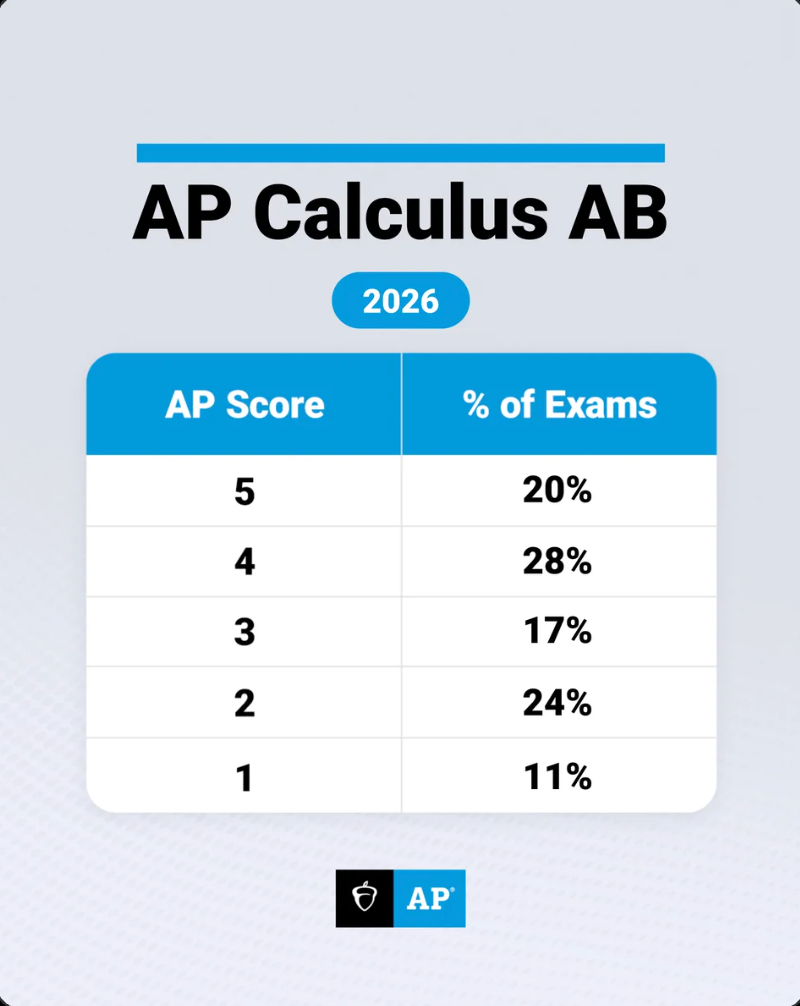
- Of all AP Calculus test takers, 20% scored, 28% scored 4, 17% scored 3, 24% scored 2, 11% scored 1. The distribution is bimodal, not a bell curve.
AP scores are out. Whether you're the student who sat the exam or the parent reading alongside them, the first question is usually the same: what does this number actually mean, and how was it decided?
This guide walks through the full process — how raw points are earned, how the final 1–5 score is set, and what your score reveals about where you stand — with a worked example for AP Calculus AB, the most widely taken AP math exam in the US, with over 292,000 students sitting it in 2026. (College Board, Trevor Packer)
The AP Scoring Scale: What 1 Through 5 Means
These labels are College Board's official designations. (College Board AP Score Scale)
| Score | Official Label | College Grade Equivalent | What it meant in AP Calculus AB 2026 |
|---|---|---|---|
| 5 | Extremely well qualified | A | Earned the hardest integration questions — topics that stumped most test-takers |
| 4 | Very well qualified | A–, B+, B | Solid command across all topics |
| 3 | Qualified | B–, C+, C | Could handle most topics; stumbled on reasoning-based FRQ questions |
| 2 | Possibly qualified | — | Unable to earn points on integration (Unit 6) questions |
| 1 | No recommendation | — | Broad foundational gaps across multiple units |
Exam-specific column from the College Board's post-exam analysis. (Trevor Packer, AP Program, 2026) — full score-by-score commentary in the section below.
How AP Scores Are Calculated: Three Steps
Step 1 — The Raw Score
Every AP exam has two sections:
- Multiple Choice (MC): 1 point per correct answer. No penalty for wrong answers. Machine-scored.
- Free Response (FRQ): Written answers scored by trained AP readers each June, using detailed rubrics. Partial credit is awarded — a student who sets up a problem correctly but makes a calculation error still earns points. This is why conceptual understanding matters more than computation speed on AP exams.
For AP Calculus AB, the structure breaks down as: (College Board, AP Calculus AB Exam)
- 45 MC questions × 1 point = 45 raw MC points
- 6 FRQ questions × 9 points each = 54 raw FRQ points
- Total raw score: 99 points (45 + 54 = 99)
AP Calculus BC has the identical structure: 45 MC + 6 FRQ = 99 raw points. The difference between AB and BC is the content covered, not the scoring structure.
Why AP exams reward conceptual clarity over speed: FRQ rubrics give credit for correct mathematical reasoning at each step — even when the final answer is wrong. A student who memorises procedures without understanding them earns nothing on a question that tests the why. A student with genuine conceptual understanding earns partial credit even on questions they can't finish.
Step 2 — The Composite Score
The raw MC and FRQ scores are not simply added together. To ensure both sections contribute equally (50% each), the MC raw score is first scaled up before combining.
For AP Calculus AB, the MC section has a maximum of 45 raw points and the FRQ section has a maximum of 54. To make them equal weight, the MC raw score is multiplied by a scaling factor (54 ÷ 45 = 1.2) before being added to the FRQ raw:
Formula: Composite Score = (MC raw × 1.2) + FRQ raw — giving a range of 0–108 for both AP Calculus AB and BC.
The table below shows how this differs across AP math exams, based on College Board's published exam structures:
| AP Exam | Section Weight | Raw Max | Composite Scale |
|---|---|---|---|
| AP Calculus AB | 50 / 50 (MC / FRQ) | 99 pts | 0–108 |
| AP Calculus BC | 50 / 50 (MC / FRQ) | 99 pts | 0–108 |
| AP Statistics | 50 / 50 (MC / FRQ) | ~100 pts | 0–100 |
| AP Precalculus | 75 / 25 (MC / FRQ) | ~64 pts | 0–100 |
Composite scale estimates based on published exam structures. College Board does not publish official composite score scales.
Why the AP Precalculus weighting matters: 75% of your score on AP Precalculus comes from multiple choice. Exam strategy — pacing, elimination, calculator use — carries more weight here than in Calculus.
Step 3 — Converting to the 1–5 Scale
The composite score is mapped to the final 1–5 score using a conversion table set by College Board each year through a process called standard setting — a panel of college professors and AP teachers determines the composite score threshold for each scaled score band, calibrated to actual college-course performance data. (College Board, Score Setting and Scoring)
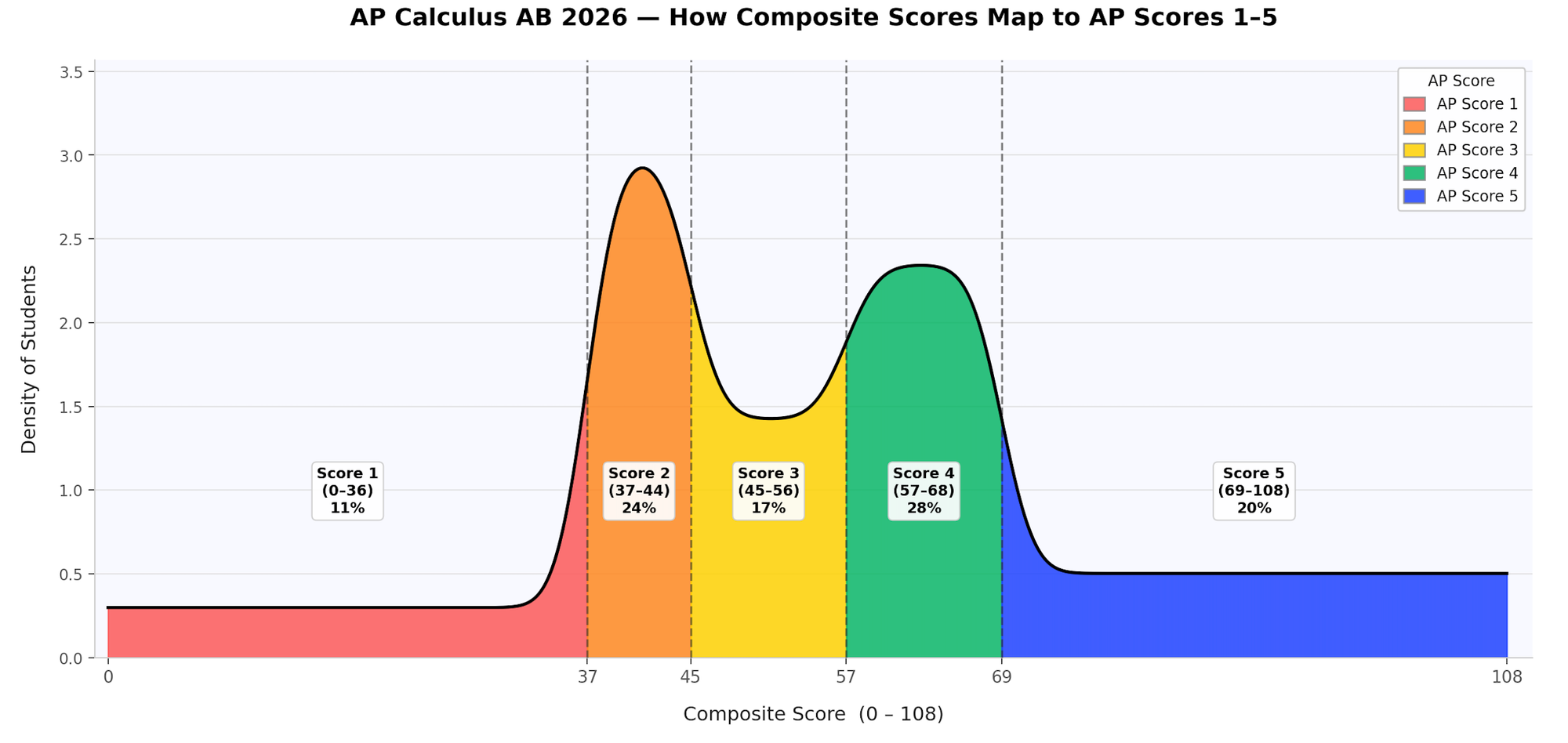
This conversion table is not published. The estimated cutoffs for AP Calculus AB, based on the exam structure, are:
| AP Score | Estimated Composite Range | Band Width |
|---|---|---|
| 5 | 69–108 | 40 points |
| 4 | 57–68 | 12 points |
| 3 | 45–56 | 12 points |
| 2 | 37–44 | 8 points — the narrowest |
| 1 | 0–36 | 37 points |
Estimates based on exam structure and historical scoring patterns. College Board does not publish official cut scores — actual thresholds may shift slightly each year.
On year-to-year consistency: College Board uses equating to ensure scores are comparable across multiple versions of the same exam. The result, across three consecutive years, is a distribution that barely moves:
| Score | 2024 | 2025 | 2026 |
|---|---|---|---|
| 5 | 21.4% | 20.3% | 20% |
| 4 | 27.8% | 28.9% | 28% |
| 3 | 15.3% | 15.0% | 17% |
| 2 | 22.7% | 22.8% | 24% |
| 1 | 12.9% | 13.0% | 11% |
| Pass rate (3+) | 64.4% | 64.2% | 65% |
Sources: College Board 2024 distributions, 2025 distributions.
A 3 in 2026 means roughly the same thing as a 3 in 2024. The passing threshold has held within 1 percentage point across all three years.
Not ready to sign up yet?
Explore free Cuemath concept videos and math puzzles — built around the kind of reasoning AP exams actually test.
Explore free concept videos →Is a 3 a Good AP Score?
Most people assume a 3 puts you somewhere in the middle — the average result. The data shows something more interesting.
Score 3 is not the average. It is the rarest meaningful score.
Only 17% of AP Calculus AB students scored a 3 in 2026. Fewer than the 24% who scored a 2. Fewer than the 28% who scored a 4.
The chart explains why. The distribution is not a bell curve. It has two distinct peaks — one in the Score 2 band, one in the Score 4 band — with Score 3 sitting in the dip between them. This is not a quirk of 2026. The pattern held in 2024 (15.3% scored 3) and 2025 (15.0% scored 3).
What the two peaks represent:
The students who took AP Calculus AB in 2026 are not a random sample of high schoolers. They split into two distinct populations:
- Cluster 1 — underprepared (Scores 1–2, 35%): Students who attempted AP Calculus without a solid enough precalculus foundation, or whose preparation did not include genuine mastery of integration. They engaged with the material but could not convert it on exam day.
- Cluster 2 — well-prepared (Scores 4–5, 48%): Students who had the foundational depth — whether through strong coursework, tutoring, or dedicated practice — to handle integration questions and earn points across all units.
Score 3 students (17%) sit in the gap between these two clusters. They crossed the passing threshold. They demonstrated enough understanding to engage the integration questions. But they do not yet have the depth of the Score 4–5 cluster.
You are not average. You are in the smallest group — the one that passed the hardest conceptual test in the exam but hasn't fully owned it yet. For a deeper look at what a 3 means across different colleges and courses, see Is 3 a Good AP Score? Here's What It's Actually Worth.
What this signals to a college: You attempted a college-level exam and passed it. You are demonstrably not in the underprepared cluster. You are a student with real mathematical ability whose preparation has not yet reached its ceiling.
The real question is not whether a 3 is good. It is which direction you are moving from here.
The Score 3 band sits at the sharpest transition point in the entire distribution — 8 composite points from a 2, 12 composite points from a 4. Both of those distances are smaller than at any other point in the scale.
What Your Score Means — and What to Do Next
All data below is specific to AP Calculus AB 2026.
If you scored a 5
You earned points on the two hardest integration questions on the exam — questions that most other test-takers could not answer. College credit is secured at virtually any institution. You demonstrated college-level command, not just college-level familiarity.
The meaningful next question: what comes after Calculus AB? AP Calculus BC, multivariable calculus, linear algebra, and competition mathematics are all within reach. The summer between exams is the highest-leverage time to move forward, not to rest.
If you scored a 4
You had solid command across all units, including integration. Most colleges will grant you course credit and placement. You were in the largest single score band — 28% of test-takers.
The students who move from 4 to 5 on a retake, or who excel in BC, are those who build genuine depth on integration over the summer — not just familiarity with the procedures, but fluency with the concepts.
If you scored a 3
You are in the smallest score band. You crossed the integration threshold — the defining conceptual gate of the 2026 exam — but you do not yet own it.
The composite score gap between a 3 and a 4 is 12 points. That is roughly the equivalent of getting a few more integration-related MC questions right and earning more partial credit on the FRQ integration questions. The gap is specific. It is not about studying harder across the whole syllabus — it is about building depth on the unit that separates the two clusters.
You are at the threshold — not below it. Score 3 students are exactly the cohort where focused tutoring makes the greatest difference. The foundation is there. The missing piece is specific. A Cuemath tutor works from your diagnostic results to target the exact areas costing you points — not the whole syllabus, not where you're already strong.
If you scored a 2
No college credit. But a 2 on AP Calculus AB — the second-most common result, held by 24% of test-takers — tells you something specific: you engaged with the material at a genuine level but were unable to earn points on integration questions.
The composite gap between a 2 and a 3 is 8 points — the narrowest transition in the entire scale. The students who move from a 2 to a 3 or 4 do not do it by studying the whole curriculum again. They do it by understanding what integration actually means — not the procedure, but the concept — and building the FRQ communication skills that turn conceptual understanding into exam points.
If you scored a 1
A 1 is uncommon (11% of test-takers in 2026, down from 13% in 2024). It signals gaps that precede integration — in functions, algebraic manipulation, or the foundational limit and derivative concepts that Unit 6 builds on.
The right response is not to re-enrol in AP Calculus. It is to rebuild the foundation. A student who retakes AP Calculus without addressing precalculus gaps will encounter the same wall.
See exactly where your score gap is
A Cuemath tutor starts with a diagnostic — so you know precisely which concepts to work on, not just 'study more calculus.'
Book a free evaluation →Frequently Asked Questions
Does my AP score affect my high school GPA?
No. Your AP exam score is completely separate from your GPA. Your GPA reflects the grade your teacher assigned for the AP course. The exam score has no bearing on it.
Does an AP score affect college GPA?
No. AP credits substitute for or waive a college course requirement, but they do not generate a grade that factors into college GPA. You enter college with credit — not with a transcript grade.
Do I have to report a low AP score to colleges?
No. AP scores are self-reported on college applications. You choose which scores to include. The official score report College Board sends directly to colleges is a separate step that you authorise and pay for. You are not obligated to send scores you would rather not share.
Can I retake an AP exam?
Yes. AP exams are offered once a year, in May. You can retake any exam in a future year, including after graduating from high school. For the full rules, costs, and whether retaking is worth it, see our guide: Can You Retake AP Exams?
Which colleges accept a score of 3 for credit?
Most public universities and many private colleges accept a 3. Selective universities — including much of the Ivy League, MIT, and Caltech — typically require a 4 or 5. For a detailed breakdown by institution, see Top Colleges That Give Credit for AP Scores.
Does reporting a 2 or 3 hurt a college application?
Reporting a low score can signal difficulty with the material. Many counselors advise against reporting scores below a 4 unless a specific institution requires all scores. Your course grade — which is on your transcript regardless — carries more weight than the exam score in most admissions contexts.
What is the difference between AP Calculus AB and BC?
BC covers all AB content plus additional topics: sequences, series, and further integration techniques. Both exams use the same structure (45 MC + 6 FRQ, 50/50 weighting) and the same composite scale (0–108). In 2026, 46% of BC test-takers scored a 5 — reflecting the more self-selected, advanced group that typically sits BC. A 3 on BC signals broader mathematical range than a 3 on AB, and many colleges treat credit awards differently as a result.
My score was low but my class grade was an A or B. Why?
AP class grades reflect coursework, in-class tests, homework, and participation — all set by your teacher. The AP exam is calibrated against actual college-course performance. In-class AP assessments are typically more generous than the exam itself. A student can earn an A in an AP class and score a 2 on the exam — this is common, and it almost always means the in-class tests did not prepare for College Board's standard.
The Score Is a Starting Point
A 1–5 is a snapshot of one exam on one morning. It reflects preparation, familiarity with the exam format, and the specific questions that appeared. It is data, not a verdict.
For most AP Calculus AB students, the answer in 2026 points to the same place: integration. Whether you scored a 3 and want to reach a 4, or a 2 and want to reach the passing threshold, the conceptual work is specific and the timeline is real.
References
- College Board AP Score Scale
- College Board AP Calculus AB Exam Structure
- College Board AP Calculus BC Exam Structure
- College Board AP Score Setting and Scoring
- College Board AP Equating Process
- AP Calculus AB 2024 Score Distributions
- AP Calculus AB 2025 Score Distributions
- Trevor Packer — 2026 AP Calculus AB scores and analysis
- Trevor Packer — 2026 AP Calculus BC scores
- Math Medic — 2026 AP Calculus FRQ analysis