Cuemath vs Kumon: Which is Actually Better for US Students in 2026?
In this blog, we compare Cuemath's live 1:1 tutoring vs. Kumon's practice-based model. We analyze curriculum alignment, cost, and the real-world parent experience to help you choose.

| Cuemath | Kumon |
|---|---|
| Live, 1:1 online math tutoring. A tutor teaches each session in real time and builds a learning plan mapped to US Common Core standards and the student's school syllabus. | Self-learning, worksheet-based math. Students complete a daily worksheet set, about 30 minutes per subject, and move up through Kumon's own level sequence at their own pace. |
| Built around school-curriculum support and live concept explanation, for students who want a tutor to work through problems with them, including middle and high school math. | Built around computation fluency and independent study habits, starting as early as age 3, and designed to run alongside school as daily at-home practice. |
Kumon details as described in Kumon's Parent's Guide (2024). Cuemath details per cuemath.com. Verified August 2026.
Cuemath is a 1:1 online math tutoring program. Based on your child's grade level and goals, each student is matched with an expert tutor who builds a personalized learning plan to help them keep up with school math, prepare for tests, or get ahead of grade level.
Kumon is a self-learning, worksheet-based program. After an initial assessment, students are placed at a comfortable starting level and work through individualized worksheets daily, on paper or through Kumon's tablet app, Kumon Connect. As Kumon describes its method, instructors guide students with hints and feedback rather than lecturing or directly teaching, so children work through the material largely on their own (Kumon Parent's Guide, 2024).
There are major differences between Cuemath and Kumon. We compare both Cuemath and Kumon across teaching model, curriculum, and cost, so you can make the call.
- How do Cuemath and Kumon compare side by side?
- What is Cuemath and how does it work?
- What makes Cuemath different?
- What are the pros and cons of Cuemath?
- What do parents say about Cuemath?
- What is Kumon and how does it work?
- How does the Kumon method work?
- What are the pros and cons of Kumon?
- Which program fits your child better: Cuemath or Kumon?
- What does a typical week look like with Cuemath and Kumon?
- What should you ask before you enroll?
- Frequently Asked Questions
- Sources
How do Cuemath and Kumon compare side by side?
| Feature | CuemathSource: cuemath.com | KumonSource: Parent's Guide (2024) |
|---|---|---|
| Program model | Live 1:1 tutoring | Self-learning worksheets |
| Grade range | K–12 | Age 3 through high school |
| Teaching approach | Live teaching. The tutor explains each concept during the class and adjusts as the student responds | Self-learning. Students work through the worksheets and, in Kumon's words, the Instructor is there to "guide, assess and encourage" |
| Tutor | Certified and experienced; trained in pedagogy and child psychology | Franchise center Instructor; guides worksheets |
| Same tutor over time | Yes, same tutor ("looping") | Varies by center |
| Personalization | Plan from a free 55-minute evaluation; adapts every class | Individualized level and pace from a placement test |
| Flexibility to your child's needs | Re-teach earlier grades, a game-like approach, or high-school and test help; the same tutor adjusts | Same worksheet method for all; individualized by level |
| Curriculum | Common Core and state standards | Kumon's own sequence (a supplement to school) |
| Geometry | Taught as a separate strand, aligned to Common Core geometry standards | Kumon's published level chart lists one continuous math sequence, from counting through calculus, rather than a separate geometry strand (source link) |
| Test and competition prep | SAT, AP Precalculus, AP Calculus, AMC 8, Math Kangaroo, Olympiads | Focused on building the core math sequence rather than exam-specific coaching (source link) |
| Reading offered | Math only | Math and reading |
| Starting age | Kindergarten (age 5) | Age 3 |
| Practice between classes | Interactive math practice with game-like elements | About 30 minutes of daily worksheets, with parents supporting the routine at home (source link) |
| Platform | Interactive smart whiteboard + gamified rewards | Paper or Kumon Connect tablet |
| Feedback | Real-time during the live class | Daily grading |
| Scheduling | Flexible, online, reschedule anytime | Two center visits per week, in person or virtual, plus practice at home on the other days (source link) |
| Cost | From $15 per class, after a free evaluation | Set by each independently owned center and shared with families at enrollment (source link) |
| Trial and cancellation | Free evaluation, 100% refund guarantee, no minimum commitment | Trial and billing terms are set by each independently owned center (source link) |
Cuemath details as described at cuemath.com. Kumon details as described in Kumon's Parent's Guide (2024). All details verified August 2026.
What the table adds up to: both programs can work, and the right one depends on the child. Families who want live teaching, school-aligned support, a separate geometry strand, test prep, and the same tutor over time may prefer Cuemath. Families who want a very early start from age 3, paper-based daily practice, arithmetic speed, or reading alongside math may prefer Kumon.
What is Cuemath and how does it work?
| Cuemath — At a Glance | |
|---|---|
| Grades Covered | K–12 |
| Format | Live 1:1 online classes |
| Same Tutor | Yes, same certified tutor over time |
| Curriculum Alignment | US Common Core and state standards |
| Cost | Starts at $15/class, after a free evaluation |
| Session Length | 60 minutes |
| Free Evaluation | One free 55-minute 1:1 evaluation with a MathFit Specialist, plus a MathFit Report, no credit card required |
| Scheduling | Flexible; reschedule anytime |
| Guarantee | 100% refund if you are not satisfied |
| Commitment | No minimum, cancel anytime |
| Trustpilot Rating | 4.9/5 (10,000+ reviews) |
What makes Cuemath different?
Cuemath is live 1:1 online math tutoring for grades K–12, built around one idea: teach the child, not the worksheet. A certified tutor explains concepts in real time, builds the plan around your child, and stays with them class after class. Families usually come with a specific worry, a child who is behind, anxious, or bored in math, and here is what Cuemath does about it:
- A certified tutor your child keeps. Cuemath tutors are certified and experienced, and they are trained in how children learn, not just in math. Your child works with the same tutor over time, so they build trust instead of starting over with someone new.
- Truly 1:1, and it bends to your child. Whether your child needs to go back and re-learn concepts from earlier grades, wants a more game-like class to stay interested, or needs help getting through high school math and test prep, the same tutor and plan adjust. Your child gets the tutor's full attention, not a share of it.
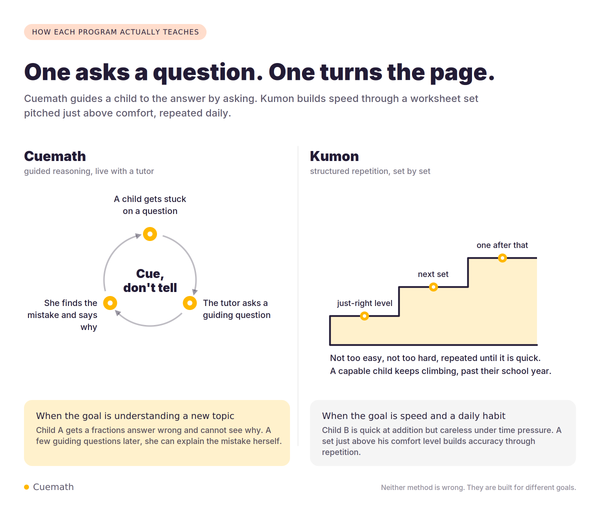
- Built for understanding, not tricks. Tutors ask questions so your child works out the answer and explains their thinking, instead of copying steps. Cuemath even tracks how much the child talks and reasons during class.
- Covers school, and what comes after. Lessons follow the Common Core and state standards for classwork and homework, include geometry, and go up to AP Precalculus, AP Calculus, SAT, AMC 8, Math Kangaroo, and Olympiad prep for children who want a challenge.
- A live, interactive class kids actually like. Tutor and child write and solve together on a shared whiteboard, and a daily practice app with games and puzzles keeps math going between classes.
- Set up for parents, too. You can schedule and reschedule around a busy week, follow progress in a parent app, start with a free evaluation, and get a 100% refund if it is not working out.
To see how a Cuemath class works, watch this short video:
How Cuemath classes work for high school?
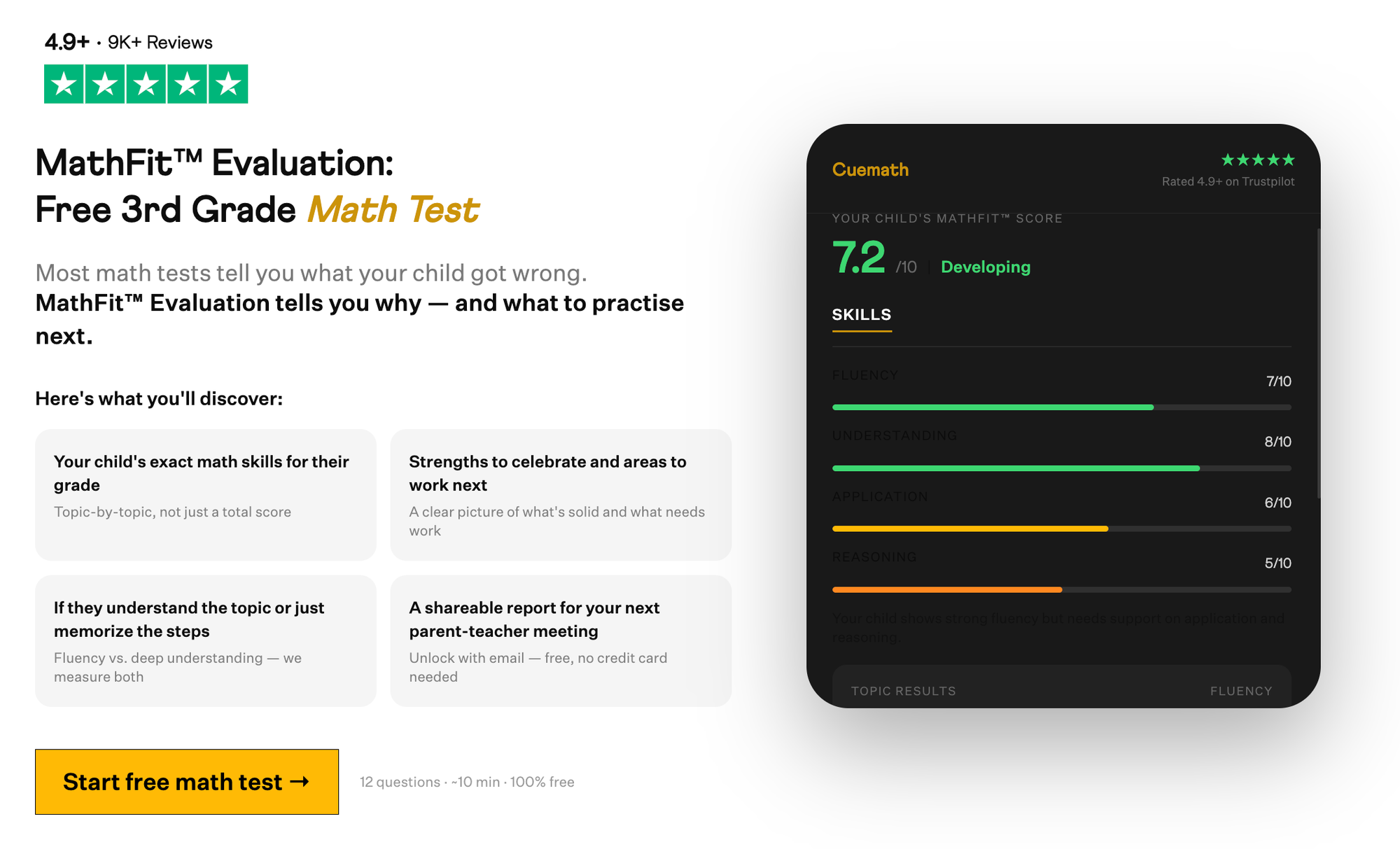
Before any paid classes begin, your child can take a free math test that identifies gaps by grade and by skill. The tutor uses the results to build a customized learning plan, and you can share the results with your child's school teacher.
The same model scales from early elementary through high school. Cuemath's published success stories include students who earned perfect 5s on AP Calculus BC and AP Precalculus, a 1570 SAT, an 818 (Advanced) on the Ohio State Test, and Math Olympiad medals (see Cuemath success stories). One 10th grader reached 1350 on the SAT after three years of consistent prep:
 Cuemath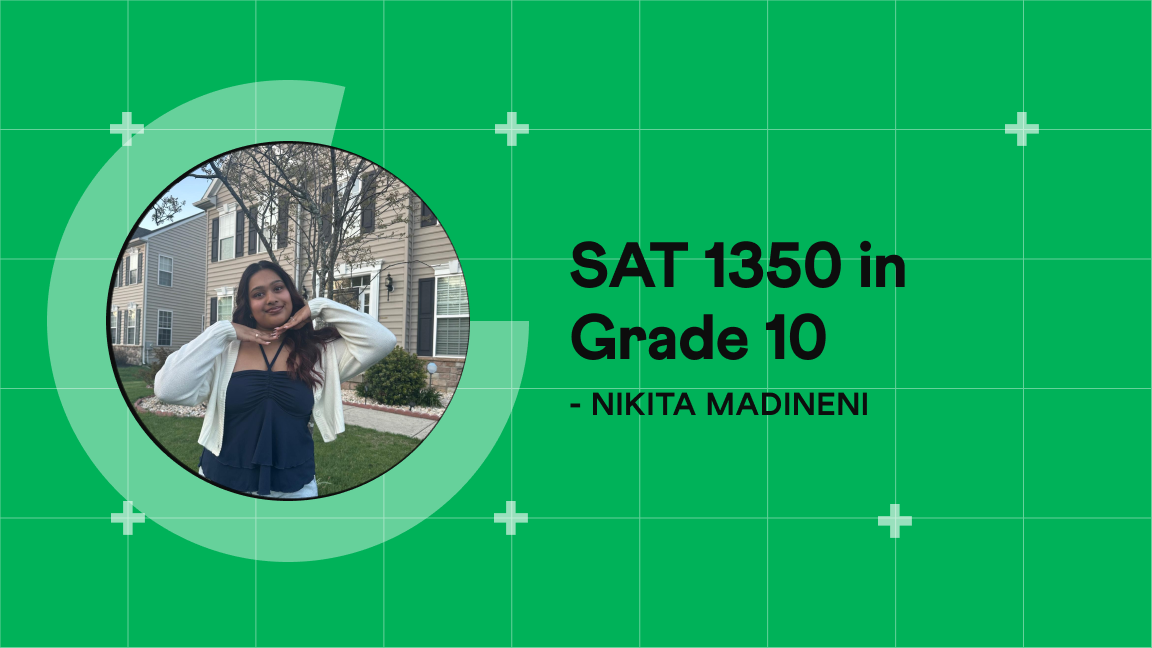
What are the pros and cons of Cuemath?
- ✅ Same certified 1:1 tutor every class, so your child builds a real relationship
- ✅ Live teaching that explains the why and adapts in real time
- ✅ Aligned to school (Common Core and state standards), plus geometry, SAT, AP courses, and competition prep
- ✅ Flexible scheduling, a free evaluation to start, and a 100% refund guarantee
- ❌ Needs a laptop or PC and reliable internet
- ❌ Online only, so not for families who specifically want a physical center or screen-free paper practice
- ❌ Math only (no reading), and starts at Kindergarten rather than age 3
What do parents say about Cuemath?
See How Your Child Actually Thinks About Math
55 minutes, one to one with a Cuemath MathFit Specialist. A guided dialogue, not a test, that reveals how your child reasons across fluency, understanding, application and reasoning. You walk away with a MathFit Report and a plan to keep.
Three steps. 55 minutes. One conversation. There is nothing to prepare; your child just shows up.
No credit card · No commitment · Grades K–12
What is Kumon and how does it work?
| Kumon — At a Glance | |
|---|---|
| Ages / Grades Covered | Age 3 through high school |
| Format | Self-learning worksheets; instructor guides, no live teaching |
| Same Instructor | Assigned center Instructor (franchise-run) |
| Curriculum Alignment | Kumon's own sequence; described by Kumon as supplemental to school |
| Cost | Set by each independently owned center and discussed with families at enrollment (source link) |
| Session Format | Center visits twice per week (in person or virtual) plus daily worksheets, about 30 min/day |
| Free Trial | Free placement test (other trial details vary by center) |
| Commitment | Trial and billing terms are set by each independently owned center (source link) |
For program details and center locations, visit kumon.com.
How does the Kumon method work?
Kumon's method is built on mastery through repetition. Students work through individualized worksheets and move to the next set only after completing the current one accurately and within a recommended time. Each worksheet steps up in small increments, so students keep building on what they already know.
Kumon can work well for a young, self-directed child who likes routine and whose parent can support about 30 minutes of daily practice. Children who stick with it often build fast, accurate mental math, and Kumon reports that many of its students in North America study above their current grade level.
The program is self-directed by design. As Kumon describes it, students learn with "no blackboards or lectures": the Instructor is there to "guide, assess and encourage," and children work each step out from the examples on the page. The aim is that students build the habit of solving on their own. Families who also want concepts explained out loud in the moment often pair that practice with live teaching. Kumon Parent's Guide, 2024
What are the pros and cons of Kumon?
- ✅ Builds genuine arithmetic fluency; students who complete it consistently develop fast, accurate mental math
- ✅ Self-paced: students advance as mastery allows, with no class cohort to wait for
- ✅ Daily practice structure builds strong study habits when parents support it
- ✅ Also covers reading, not just math
- ❌ Learning comes from the worked examples rather than from live instruction, so a child who wants a concept explained in the moment may want teaching alongside it
- ✅ Each center is independently owned and run by a local Instructor, so families deal directly with the person overseeing their child's work
- ❌ Works best when a parent can support about 30 minutes of practice at home each day
Which program fits your child better: Cuemath or Kumon?
| If your child… | Cuemath | Kumon |
|---|---|---|
| Needs concepts explained, or is behind in school math | ✓ | ✗ |
| Needs school-aligned help with classwork and homework | ✓ | ✗ |
| Wants faster, more accurate arithmetic | ✓ | ✓ |
| Is ahead and wants to keep moving forward | ✓ | ✓ |
| Needs geometry as a separate strand (source link) | ✓ | ✗ |
| Needs SAT, AP, or competition prep | ✓ | ✗ |
| Is under 5 and needs a first math routine | ✗ | ✓ |
| Also needs reading, not just math | ✗ | ✓ |
| Prefers a physical center and paper worksheets | ✗ | ✓ |
| Needs to reschedule around a changing week | ✓ | ✗ |
✓ the program is designed for this · ✗ not what this program is designed for. Kumon details as described in Kumon's Parent's Guide (2024).
Many families fit more than one profile. In general, students who benefit from personalized guidance and help with school math may prefer a live tutoring program, while those focused on building a consistent daily arithmetic practice routine may find a structured practice program more suitable. Ultimately, the best option depends on the student's individual learning needs and goals.
What does a typical week look like with Cuemath and Kumon?
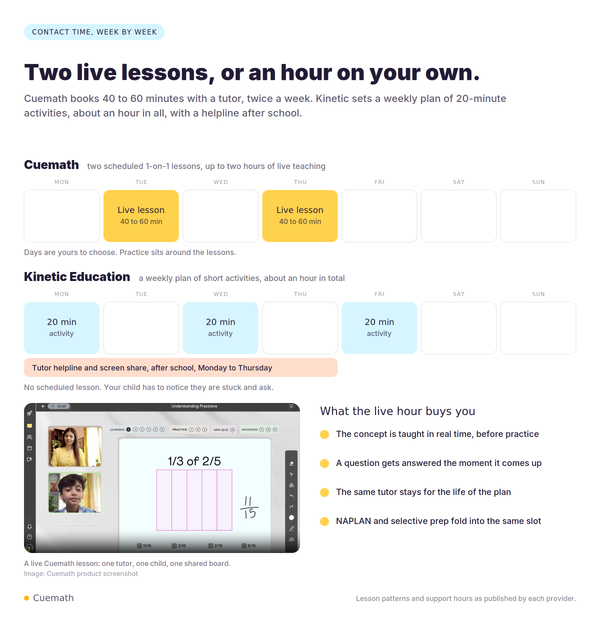
Time and parent involvement are where the two feel most different day to day. Here is the honest rhythm of each.
- Live 1:1 classes with the same tutor, at times you choose and can reschedule
- 60-minute classes where the tutor teaches and adapts as they go
- Short, game-based practice on the app between classes
- You follow progress in the parent app
- Parent role: light; the tutor drives the learning
- Two center visits (in person or virtual)
- About 30 minutes of worksheets every day, including the five days at home
- The instructor assigns and grades; your child works largely on their own
- You can follow progress through the myKUMON dashboard
- Parent role: bigger; you set a daily Kumon time and help younger children at home
Source: Kumon Parent's Guide (2024)
What should you ask before you enroll?
Whichever way you lean, a few questions up front save money and frustration. Because Kumon centers are independently owned, in our view details like pricing, trials, and instructor consistency can vary by location, so it is worth confirming directly.
| What to ask about | For a live tutoring program (like Cuemath) | For a center or self-study program (like Kumon) |
|---|---|---|
| Tutor or Instructor consistency | Will my child have the same tutor every class? | Will my child work with the same Instructor each visit, and how many students share one Instructor? |
| Qualifications and training | What are the tutor's qualifications and training? | What training does the Instructor have? |
| When my child gets stuck | How does the tutor handle a concept my child cannot follow? | What happens when my child gets stuck on a concept at home? |
| First step and trial | Is there a free evaluation before you commit, and is a credit card required? | Is there a free trial class, or only a placement test? |
| Personalization and progress | How is the plan personalized, and how will I see progress? | How is the starting level set, and how is progress shared with me? |
| Cost | What does it cost per class, and what is included? | What is the monthly fee per subject, and is there a registration or materials fee? |
| Commitment | Is there a minimum commitment, and can I cancel anytime? | Is there a minimum commitment, and what notice is needed to pause or cancel? |
| Format and materials | What device and setup does my child need at home? | Paper worksheets or the tablet option, and how much daily practice is expected? |
Not Sure Which One Fits? Try Before You Decide
Both programs can work, and the choice is yours. The easiest way to decide is to take each program's first step. Kumon's standard first step is a free placement test that assesses your child and assigns a starting level, and trial sessions vary by center (source). Cuemath's free first step is a 55-minute 1:1 evaluation with a MathFit Specialist.
In your child's free Cuemath evaluation, they get:
- A 55-minute 1:1 conversation, not a test, with a Cuemath specialist who works through problems with your child
- A MathFit Report covering fluency, understanding, application and reasoning, which shows the concept where your child is stuck
- A plan around your child's actual school work, aligned to the US Common Core, including geometry and test prep
- The same dedicated tutor if you continue, so your child builds a real relationship instead of starting over
- No credit card and no commitment
Grades K–12 · No credit card required · Starts within days of booking
Frequently Asked Questions
Is Cuemath better than Kumon?
They are built for different goals, so neither is better in the abstract. Cuemath may be a better fit for families seeking live 1:1 instruction and personalized concept support, including school-aligned math, geometry, and test prep. Kumon may be a better fit for a child whose main goal is building daily arithmetic fluency and study habits through worksheet practice.
What is the difference between Cuemath and Kumon?
Cuemath is live 1:1 tutoring: a dedicated tutor explains concepts, adapts in real time, and works through your child's school curriculum. Kumon is a self-learning worksheet program: children work through individualized worksheets on paper or a tablet and, as Kumon puts it, learn with "no blackboards or lectures," with the Instructor there to "guide, assess and encourage" (Kumon Parent's Guide, 2024).
How much does Cuemath cost compared to Kumon?
Cuemath starts at $15 per class, and the first step is a free evaluation. Kumon's fees are set by each independently owned franchise center and are shared with families at enrollment (Kumon Parent's Guide, 2024).
At what age should I start Kumon or Cuemath?
Kumon accepts children from age 3. Cuemath starts at Kindergarten (age 5). Kumon may be an option for children under 5 among these two programs. From age 5 up, the right choice depends on whether your child needs school-aligned teaching (Cuemath) or a daily practice routine (Kumon).
Does Kumon cover geometry?
Kumon's published math sequence runs from arithmetic through algebra to calculus, listed as one continuous sequence rather than a separate geometry strand (Kumon Parent's Guide, 2024). Geometry appears in the Common Core standards from Kindergarten through Grade 8, so parents may wish to consider whether additional geometry support is needed alongside the program.
Is Kumon good for high school students?
It depends on the goal. Kumon's upper levels are self-directed and reach high-school calculus content, with the focus on its own math sequence rather than exam-specific coaching. For extra self-paced practice, Kumon can supplement school. Students seeking personalized instruction or school-specific support may also benefit from a live tutoring program.
Is Cuemath good for students who are behind in math?
Cuemath includes an initial assessment to identify learning gaps and personalize instruction. Before any paid classes begin, your child takes a free 55-minute evaluation that identifies the concept where the gap starts, and the tutor builds each session around that concept rather than the standard grade-level sequence.
Can Kumon help with SAT prep?
Kumon is not specifically designed for SAT preparation, and some students may also benefit from SAT-focused instruction. Kumon's program focuses on its own math sequence rather than test strategy (Kumon Parent's Guide, 2024).
How do the introductory experiences compare?
They offer different things. Cuemath's first step is a free 55-minute 1:1 evaluation with a MathFit Specialist that ends with a MathFit Report and a recommended plan, with no credit card required. Kumon's standard first step is a free placement test, and trial sessions vary by center (Kumon Parent's Guide, 2024).
Is Kumon worth it?
If your child is young, enjoys routine, your main goal is daily arithmetic fluency, and you can support about 30 minutes of practice a day, many families find Kumon worthwhile. Families seeking personalized instruction may prefer a tutoring-based program, while others may find Kumon worthwhile for building consistent arithmetic practice.
Sources
Kumon (program, method, and curriculum)
- Kumon Parent's Guide, 2024 (self-learning method, "no blackboards or lectures," ~30 min/day, twice-weekly center visits, paper or Kumon Connect tablet, math level sequence, and supplemental positioning): kumon.com Parent's Guide (PDF)
- Kumon — How Kumon Works (self-learning format, instructor role): kumon.com/how-kumon-works
- Kumon — Math Program (curriculum scope: one continuous sequence from arithmetic through calculus): kumon.com/math-program
Cuemath
- Trustpilot — Cuemath reviews (4.9/5, 10,000+ reviews): trustpilot.com/review/cuemath.com
- Cuemath — Student success stories: cuemath.com/blog/tag/impact-stories

I grew up a science kid. Math was not my best subject. Class moved fast, I was too shy to ask for help, and I somehow ended up more curious about how people learn than about the subjects themselves.
That's what pulled me into education, not to teach, but to understand how colleges and tutoring programs actually work and what students genuinely need from them.
My love for writing did the rest. I had too many observations and nowhere to put them, so I started writing, and haven't stopped. Over the last five years I've written about edtech, student life, and college programs. For the past year, my focus has been math tutoring specifically.
I work at Cuemath now, so factor that in. I research by going where parents actually talk: forums, reviews, and direct conversations with students and families. I'm writing for the kid who's too scared to raise their hand in class. I was that kid.