12 Back-to-School Math Activities for Middle School
12 fun, hands-on math activities to restart the year with 6th, 7th, and 8th graders. Each activity is quick 15 to 20 minutes, has various difficulty levels, and comes with a quick way to assess student's readiness for next school year.

Summer is ending, and your middle schooler probably has not thought about math in ten weeks. Some are walking into a harder grade than the one they left. Others spent the whole break avoiding anything that looked like a number. Either way, the first two weeks of the year decide a lot: whether they show up curious or already shut down.
That is exactly what these back-to-school math activities for middle school are built for. This guide has 12 activities for grades 6, 7, and 8, and none of them feels like a worksheet. They run in 15 to 20 minutes, work in a classroom or at the kitchen table, and each one comes with three difficulty levels and a quick way to check what your child actually understands before formal school begins.
Every activity here was reviewed by Cuemath's expert tutors and mapped to Common Core skills, so the fun is doing real math, not busywork dressed up as a game. Last reviewed: July 2026.
- All 12 Middle School Math Activities at a Glance
- 9 Fun Back-to-School Math Activities for Middle School
- Outdoor Math Activities for Middle School
- Easy, Low-Prep Math Activities for Middle School
- Best Back-to-School Math Activities by Grade (6th, 7th, 8th)
- Back-to-School Math Activities for 6th Grade
- Back-to-School Math Activities for 7th Grade
- Back-to-School Math Activities for 8th Grade
- Math Games and Tutoring Cuemath Tutors Recommend
- Frequently Asked Questions
- Sources
School math + test prep + skills AI can't match, at $0 cost.
Everything your child needs from Grade K to 12, curriculum mastery, test prep, and enrichment math, is now in one free app.
Simple log in with email, nothing else
All 12 Middle School Math Activities at a Glance
Jump straight to any activity below, see the concept it builds, and check whether it works at home as well as in class.
| Activity | What it teaches | Can be done at home? |
|---|---|---|
| Math Bingo | Arithmetic fact fluency | Yes |
| Stand Up or Sit Down | Equation reasoning | Yes |
| "Which Is Largest?" Relay | Comparing and ordering numbers | Yes |
| "Make 24" Card Game | Order of operations | Yes |
| Paper-Chain Challenge | Mixed problem-solving | No |
| Math Taboo | Math vocabulary | Yes |
| "Math About Me" Posters | Number sense and arithmetic | Yes |
| Classroom Survey & Graphing | Data and graphing | No |
| Geometry Scavenger Hunt | Geometry vocabulary | Yes |
| Shadow Ratios (outdoor) | Proportional reasoning | Yes |
| Coordinate Chalk Grid (outdoor) | Coordinate plane and transformations | Yes |
| Pace-and-Estimate Walk (outdoor) | Estimation and unit rates | Yes |
9 Fun Back-to-School Math Activities for Middle School
These are the nine core activities, each with a worked example, three difficulty levels, and a quick check. They cover the full range of middle school skills: integer operations, fractions, ratios, algebraic thinking, geometry, data, and math vocabulary. Use them as daily warm-ups, lesson hooks, or end-of-week challenges.
1. Math Bingo: Fast Recall of Facts and Fractions
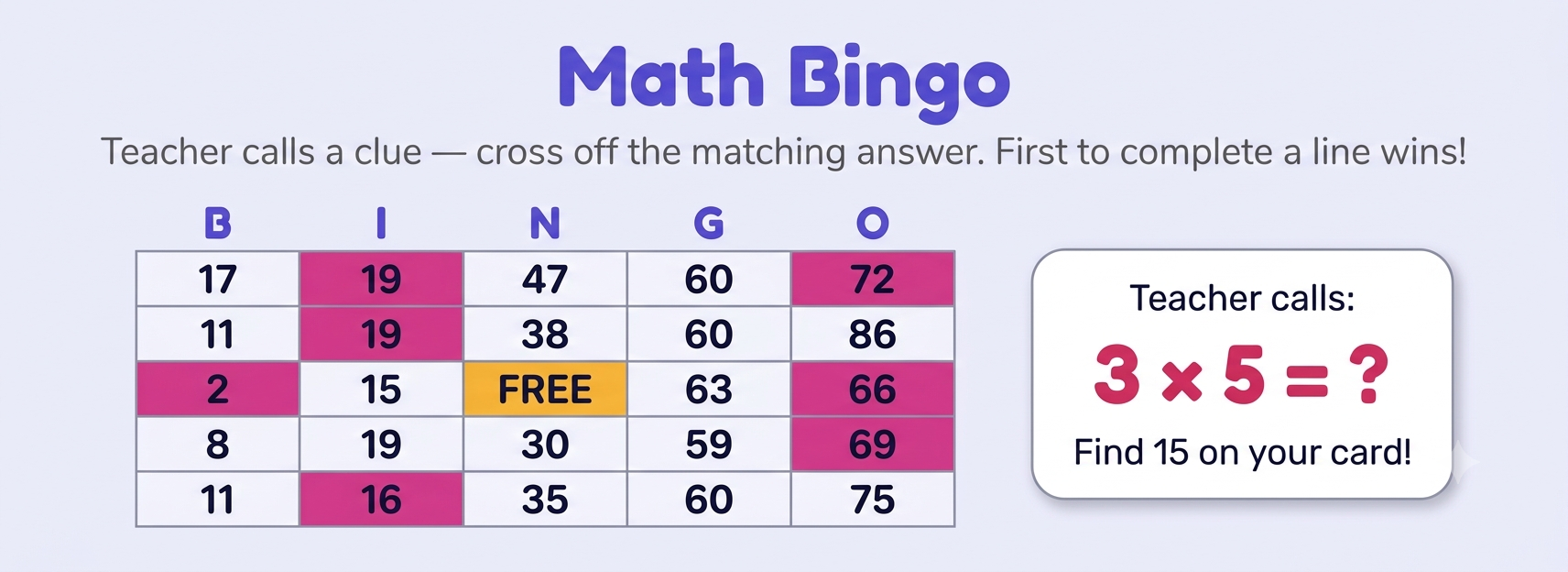
Skill: Quick recall of arithmetic, from multiplication facts to fractions and decimals.
You'll need: A 4x4 or 5x5 bingo card per student, pre-filled with answer numbers; markers or chips; a prepared list of problems to call out.
How to play:
- Give each student a bingo card. The teacher, or a student caller, reads a problem aloud, for example 7 x 8 or 3/4 + 5/8.
- Students solve it in their head or on scrap paper and cover the matching answer if they have it.
- The first to complete a row, column, or diagonal shouts Bingo, then reads back every covered answer with its original problem to verify.
Three levels:
- Easier: Single-digit operations and whole numbers only.
- On level: Mix in two-digit numbers, fractions, and decimals.
- Stretch: Add negative integers, powers, or a quick expression like find x if 2x + 3 = 11.
Quick check: Ask a winner to explain how they got one answer. That instantly tells you whether they computed it or just recognized the number on the card.
Common Core link: 6.NS and 7.NS (operations), 6.EE (basic algebra).
2. Stand Up or Sit Down: True or False Equations
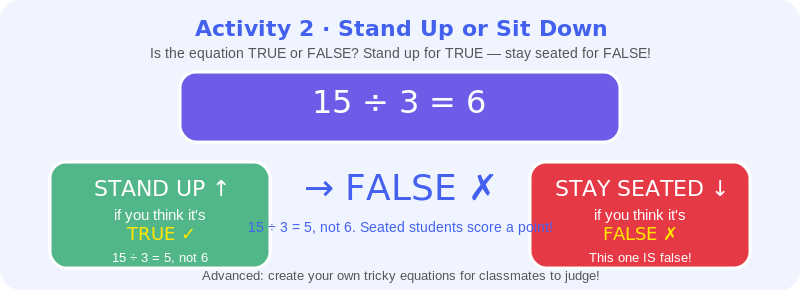
Skill: Judging whether an equation is correct, which reinforces equation solving and number sense.
You'll need: A whiteboard or projector and a prepared list of equations, some correct and some deliberately wrong, like 15 ÷ 3 = 6.
How to play:
- Read one equation aloud. Students work it out mentally or on scrap paper.
- Students stand if they think it is true and stay seated if they think it is false.
- Reveal the answer and award a point for each correct judgment. Incorrect students can sit out a round, or the losers write the next question.
Three levels:
- Easier: Integer arithmetic, like 5 x 7 = 35.
- On level: Fractions, decimals, or order-of-operations problems.
- Stretch: Multi-step or algebraic problems; invite stronger students to write tricky ones for their peers.
Quick check: After each round, ask one standing and one seated student to explain their reasoning. Sign errors and order-of-operations slips show up here while they are still fresh.
Common Core link: 6.EE to 8.EE (evaluate expressions and equations).
3. "Which Is Largest?" Relay: Solve, Then Order
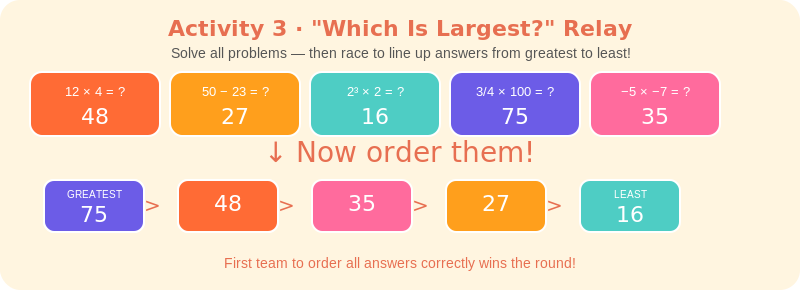
Skill: Solving a set of problems, then ordering the answers, which builds comparative number sense.
You'll need: Sets of problem cards, six to eight per set, each with a numeric answer; scrap paper; one identical set per team.
How to play:
- Split students into small teams and give each the same set of cards.
- On go, teams solve every problem and race to arrange their answers from greatest to least.
- The first team to finish correctly wins the round. Rotate who manages the cards each time.
Three levels:
- Easier: Basic operations with positive whole numbers.
- On level: Fractions, negatives, and percentages.
- Stretch: Decimals, powers, and comparing expressions; ask teams to explain why their order is right.
Quick check: Ask a team to justify their largest number using estimation. That tests whether they understand magnitude or just followed a procedure.
Common Core link: 6.NS (comparing integers and fractions), 7.NS (absolute value).
4. "Make 24" Card Game: Order of Operations Under Pressure
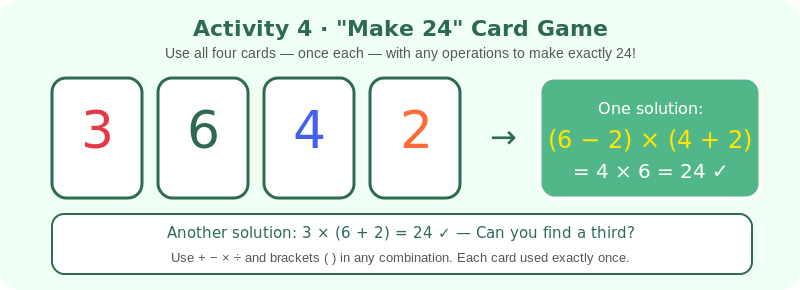
Skill: Mental calculation, order of operations, and creative arithmetic.
You'll need: One standard deck per group, Jokers removed, with Ace = 1, Jack = 11, Queen = 12, King = 13; scrap paper.
How to play:
- In groups of two to four, a dealer turns over four cards face up.
- All players race to use all four numbers, each exactly once, with +, −, ×, ÷, and brackets, to reach exactly 24.
- The first to find a valid equation shouts Got 24, writes it out, and the group verifies. A correct answer scores a point, then deal again.
Three levels:
- Easier: Allow any operations freely, with hints available.
- On level: Standard rules; each number once, any operation, brackets allowed.
- Stretch: Restrict operations, for example no subtraction, or allow square roots and exponents.
Quick check: Ask the group to explain the order of operations in their solution. That reveals whether they understand expression structure or are guessing combinations.
Common Core link: 6.EE and 7.EE (expressions, order of operations, rational numbers). Best for grades 7 and 8.
5. Paper-Chain Challenge: Every Correct Answer Adds a Link
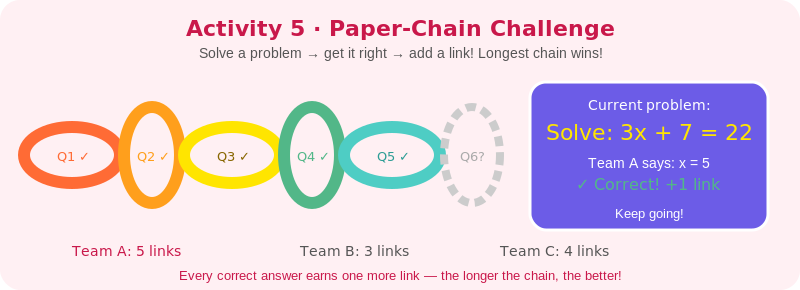
Skill: Collaborative problem-solving across any topic, from fractions to algebra to geometry.
You'll need: Strips of paper, tape or a stapler, and a set of problems that rise in difficulty.
How to play:
- Split the class into teams of three or four and post a problem for everyone.
- Teams work it out; a correct solution earns the right to add one loop to their paper chain.
- Post the next problem and keep going until time runs out. Longest chain wins.
Three levels:
- Easier: Start with straightforward problems, one link per correct answer.
- On level: Raise the difficulty to multi-step word problems, fractions, or proportions.
- Stretch: Award extra links for harder, clearly labeled problems so stronger students take bigger swings.
Quick check: Afterward, review one problem per difficulty level and ask teams to explain how they got there, or where another team's answer went wrong.
Common Core link: Flexible across any grade-appropriate content.
6. Math Taboo: Explain the Term Without the Obvious Words
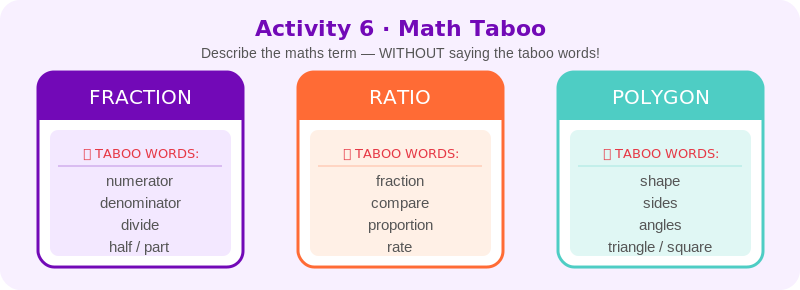
Skill: Math vocabulary, conceptual understanding, and precise language.
You'll need: A deck of term cards, each with a target math term on top and three to five taboo words below that cannot be used.
How to play:
- Split into pairs or small teams. One player draws a card and has 30 seconds to describe the term to teammates without saying any taboo word.
- A correct guess scores a point; using a taboo word loses the turn.
- Rotate players. After a few rounds, ask each team to pick one term and define it formally for the class.
Three levels:
- Easier: Basic terms like fraction, prime, sum, polygon.
- On level: Harder terms like coefficient, integer, mean, asymptote.
- Stretch: Silent mode using gestures only, or write a formal definition instead of talking.
Quick check: The quality of the description shows the depth of understanding. "It's part of something" is surface level; "a quotient of two integers where the denominator isn't zero" is conceptual. Push for the second kind.
Common Core link: 6.NS to 8.SP (number and statistics vocabulary).
7. "Math About Me" Posters: The Icebreaker That Doubles as a Diagnostic
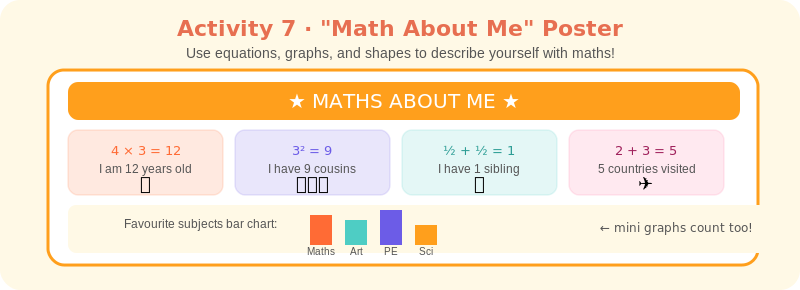
Skill: Personalizing math, reviewing arithmetic, and building community on day one.
You'll need: Paper or poster board, markers, and an optional printed template.
How to play:
- Each student makes a poster that uses math facts to describe themselves, like 4 x 3 = 12 (I am 12) or 1/2 + 1/2 = 1 (I have one sibling).
- Encourage variety: equations, shapes, bar charts, at least four facts.
- Students share in small groups or do a gallery walk so classmates learn about each other.
Three levels:
- Easier: Simple arithmetic facts only.
- On level: Mix in fractions or percentages, like 3/4 of my friends play a sport.
- Stretch: Use exponents, expressions, or a small bar or pie chart.
Quick check: As students share, listen for computation errors and address them gently. This surfaces who needs an arithmetic refresh before the real lessons start.
Common Core link: Standards for Mathematical Practice, MP1 and MP2. A natural first-day icebreaker.
8. Classroom Survey and Graphing: Real Data, Fast
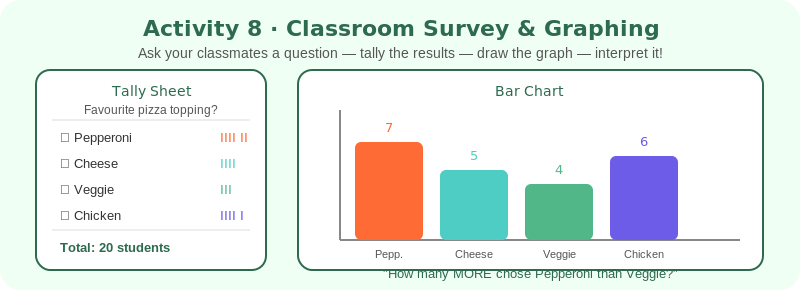
Skill: Collecting, organizing, and interpreting data, then building and labeling a graph.
You'll need: A fun survey question with three or four options, tally sheets or graph paper, and markers.
How to play:
- Pose a light question like What's your favorite pizza topping? Students vote and groups tally the responses.
- Teams turn the tallies into a bar chart, or a pie chart for advanced students, with correct axes, title, and scale.
- Discuss: which category is largest, what fraction of the class chose pepperoni, how many more chose chicken than veggie.
Three levels:
- Easier: A two-choice question and a simple bar graph with guided labeling.
- On level: Four choices, an independent graph, and basic statistics read off the chart.
- Stretch: A numeric survey like how many siblings?; calculate mean, median, and mode and compare as percentages.
Quick check: Check each graph for accuracy, scale, and labeling, then ask an interpretation question. That tests whether students can pull meaning from their own data.
Common Core link: 6.SP (statistical thinking), MP4 (model with math).
9. Geometry Scavenger Hunt: Find the Math in the Room
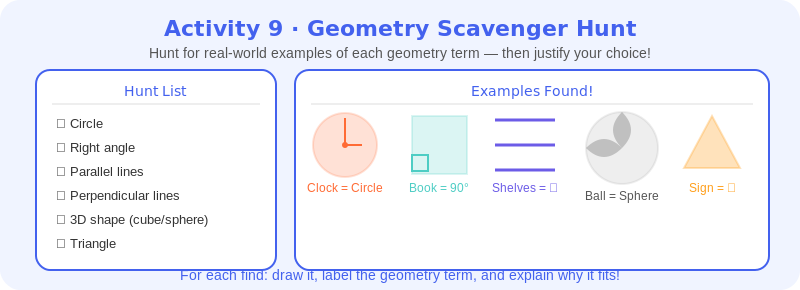
Skill: Spotting geometric shapes and properties in the real world and tying vocabulary to objects.
You'll need: A printed list of geometry terms, clipboards or notebooks, and pencils. Phones for photos are optional.
How to play:
- In teams, students hunt the classroom, or the school, for real examples of each term: circle, right angle, parallel lines, perpendicular lines, a 3D solid, triangle.
- For each find, they sketch it, label the term, and write one sentence on why the object qualifies.
- Teams share, and the class discusses any disputed choices.
Three levels:
- Easier: Basic 2D shapes with clear classroom examples.
- On level: Less obvious terms like perpendicular, vertex, edge, face, with written justification.
- Stretch: Coordinate-plane items, transformations, or solid terms like prism, pyramid, cone.
Quick check: Verify each example truly matches the term, then ask a team to draw one find and label every geometric feature. That turns the debrief into a mini-lesson.
Common Core link: 7.G and 8.G (geometric properties). Best for grades 7 and 8.
Outdoor Math Activities for Middle School
Not every activity belongs at a desk. These three outdoor math activities for middle school get kids moving and turn the schoolyard into a math lab. They work for a class or for a weekend afternoon in the backyard, and they are some of the best ways to make ratios, coordinates, and estimation feel real.
10. Shadow Ratios: Measure a Flagpole Without a Ladder
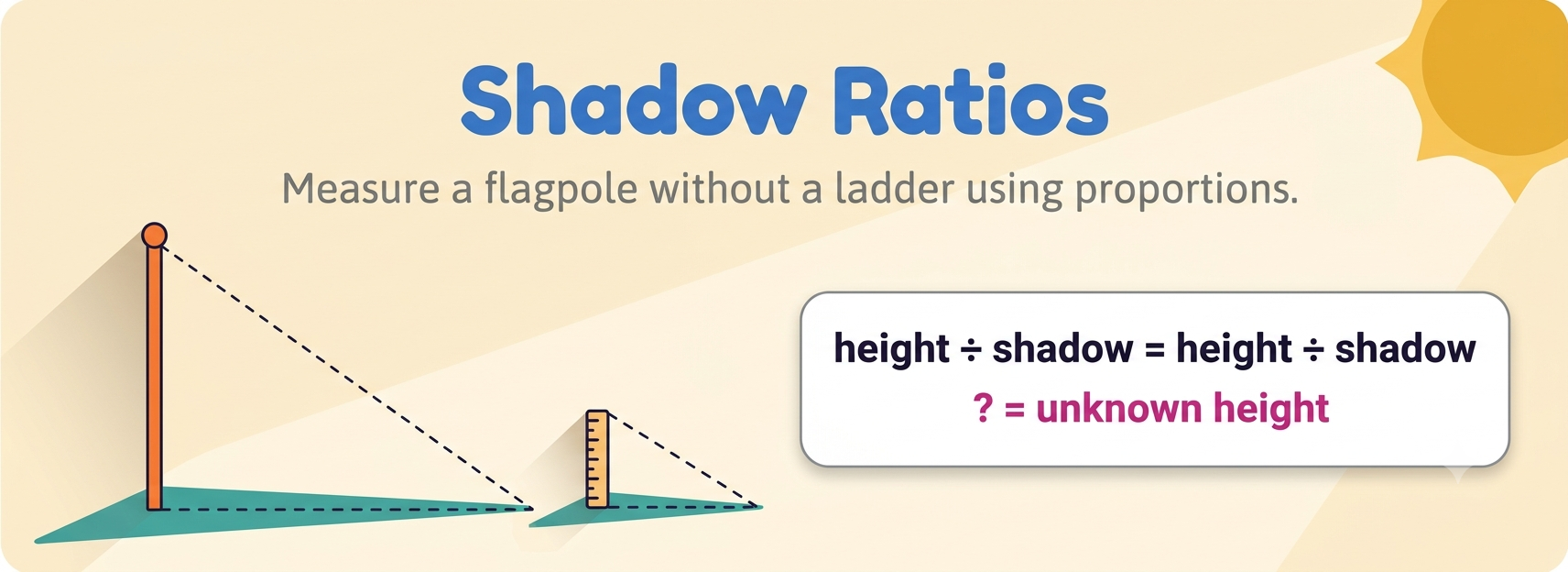
Skill: Proportional reasoning, setting up and solving a real proportion.
You'll need: A sunny day, a measuring tape, a meter stick or a student of known height, chalk, and a recording sheet.
How to play:
- Outside, each team measures the shadow of something tall, a flagpole, hoop, or tree, and the shadow of something of known height, like a meter stick.
- Because both cast shadows at the same sun angle, the ratio of height to shadow is the same for both. Teams set up known height ÷ known shadow = unknown height ÷ unknown shadow and solve for the tall object.
- Teams compare answers and discuss why they differ.
Three levels:
- Easier: Measure a teammate's height from their shadow and a meter stick.
- On level: Measure a flagpole or hoop with a clean proportion.
- Stretch: Run three trials and average them, then talk about measurement error.
Quick check: Ask why the two shadow ratios are equal. A student who points to same sun angle, so similar triangles understands the math, not just the arithmetic.
Common Core link: 7.RP (proportional relationships), 7.G (scale). Best for grades 7 and 8.
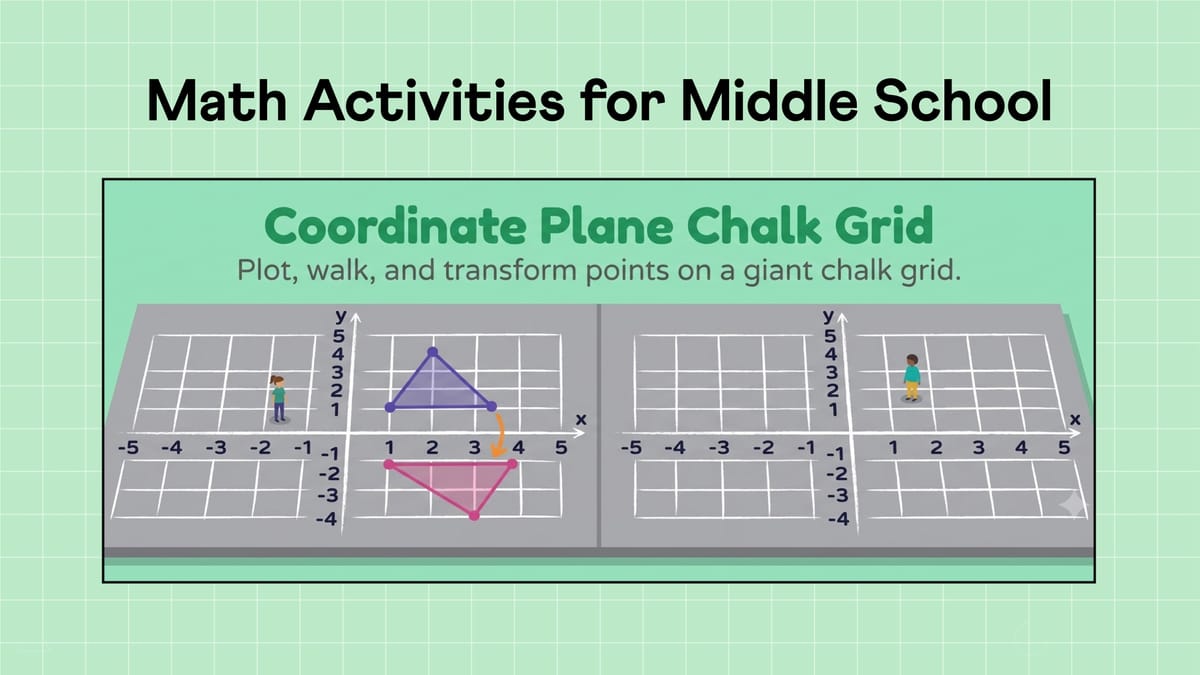
11. Coordinate Plane Chalk Grid: Plot, Walk, and Transform
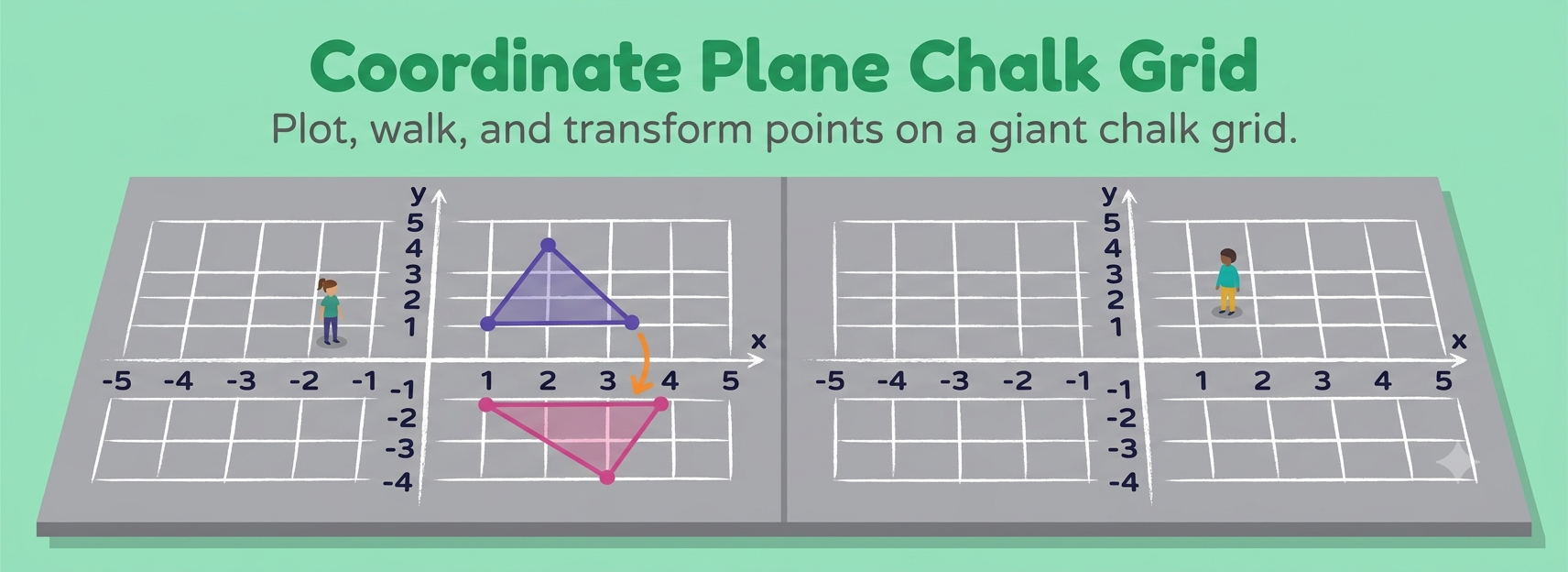
Skill: Plotting ordered pairs, and for 8th grade, translations, reflections, and rotations.
You'll need: Sidewalk chalk, an open paved area, and a list of points or shapes.
How to play:
- Teams draw a large four-quadrant grid on the pavement and label the axes.
- The caller reads ordered pairs and a student stands on each point; for a shape, students plot the vertices and connect them with chalk.
- For 8th grade, call a transformation like reflect your triangle over the x-axis or translate 4 right, 2 down, and students physically move, then chalk the new image.
Three levels:
- Easier: Plot single points across all four quadrants.
- On level: Plot and connect a polygon.
- Stretch: Perform a sequence of two transformations and write the new coordinates.
Quick check: Ask what happens to the coordinates when a shape is reflected over the y-axis. The x-values flip sign means they own the rule, not just the picture.
Common Core link: 6.NS.C (coordinate plane), 8.G.A (transformations). Good for grades 6 and 8.
12. Pace-and-Estimate Walk: Perimeter and Distance by Footstep
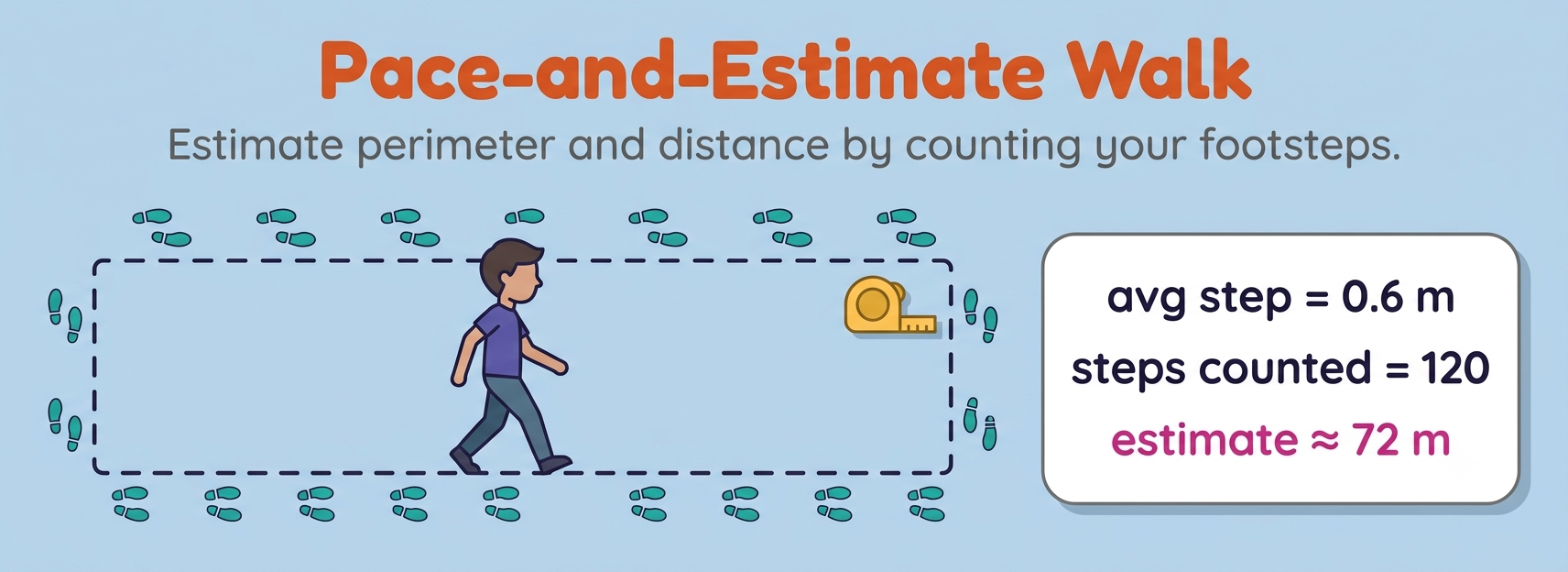
Skill: Estimation, measurement, unit rates, and perimeter across the school grounds.
You'll need: A measuring tape or trundle wheel, recording sheets, and pencils.
How to play:
- Each student measures ten of their own steps and finds their average step length.
- Teams walk the perimeter of a marked area, a court or garden bed, counting steps, and use their step length to estimate the real distance.
- They measure one section with tape to see how close they got.
Three levels:
- Easier: Estimate one straight length.
- On level: Estimate a full perimeter, then check it against a taped measurement.
- Stretch: Calculate percent error, or find a steps per meter rate and use it to estimate a longer distance.
Quick check: Ask how they would estimate the length of the whole field from step count alone. A student who reaches for a steps-per-meter rate is reasoning proportionally.
Common Core link: 6.RP and 7.RP (unit rates, proportional reasoning), 6.G (perimeter). Good for grades 6 and 7.
Easy, Low-Prep Math Activities for Middle School
Short on prep time? These are the easiest math activities for middle school on this list. Each one needs almost nothing beyond a whiteboard or a few cards, and each still does real mathematical work.
- Stand Up or Sit Down needs only a list of true-or-false equations. No handouts, no materials, five minutes to set up.
- Math Taboo needs a stack of index cards you can write in ten minutes, and it reviews a whole unit's vocabulary.
- Math About Me needs paper and markers, and it doubles as a first-day icebreaker and a quiet diagnostic.
- Math Bingo takes one round of prep to make the cards, then runs itself for the rest of the year.
- "Which Is Largest?" Relay reuses any problem set you already have; just write the answers on cards.
Best Back-to-School Math Activities by Grade (6th, 7th, 8th)
Middle school is not one grade, it is three very different years. A 6th grader is still settling into abstract math, while an 8th grader is heading toward algebra and functions. Here is how to pick from the activities above for each grade.
Back-to-School Math Activities for 6th Grade
Back-to-school math activities for 6th grade should rebuild number sense and ease students into ratios and the coordinate plane. Sixth grade covers ratios, fractions, decimals, early expressions, and basic statistics, so lead with confidence-builders and light review.
Best picks for 6th grade:
- Math About Me to break the ice on day one
- Math Bingo and "Which Is Largest?" Relay to refresh operations with fractions and decimals
- Classroom Survey and Graphing for the 6.SP statistics standards
- Coordinate Plane Chalk Grid (single points) to introduce the four quadrants
- Pace-and-Estimate Walk for unit rates and perimeter
For the full list of what your child covers this year, see what you learn in 6th grade math.
Back-to-School Math Activities for 7th Grade
Back-to-school math activities for 7th grade should push proportional reasoning and operations with negative numbers. Seventh grade is the proportions year, ratios, percentages, and rational-number operations, so pick activities that stretch into those.
Best picks for 7th grade:
- Shadow Ratios for real proportional reasoning outdoors
- Make 24 for order of operations and mental flexibility
- Stand Up or Sit Down with fractions and integers to catch sign errors early
- "Which Is Largest?" Relay with negatives and percentages
- Math Taboo with terms like ratio, coefficient, and integer
Back-to-School Math Activities for 8th Grade
Back-to-school math activities for 8th grade should preview algebra, functions, and geometry with transformations. Eighth grade covers linear equations, functions, the Pythagorean theorem, and transformations, so choose activities that reward abstract thinking.
Best picks for 8th grade:
- Coordinate Plane Chalk Grid with translations, reflections, and rotations
- Geometry Scavenger Hunt with solids and coordinate items
- Make 24 with exponents and square roots allowed
- Stand Up or Sit Down with algebraic evaluation
- Math Taboo with advanced terms like asymptote and function
For the full list of what your child covers this year, see what you learn in 8th grade math.
Math Games and Tutoring Cuemath Tutors Recommend
You have 12 activities to revise concepts with your child and a plan for the first two weeks. But pay attention to what happens while you play. If your child lights up during Make 24, or freezes on the fractions in Math Bingo, that is real information about the year ahead.
That is exactly where Cuemath fits. It is 1:1 live online tutoring for grades 6 to 8, built around your child's own pace and learning goals, not a fixed class everyone sits through.
Cuemath tutors lean on exactly these kinds of games and activities to make abstract math click. It is one reason families of more than 200,000 students across 80+ countries trust it, with a 4.9 out of 5 rating from over 10,000 reviews on Trustpilot. Plans start at $25 per class, and the first evaluation is free.
So you have two easy ways to see if it clicks for your child:
Frequently Asked Questions
What are the best back-to-school math activities for middle school?
The best back-to-school math activities for middle school are short, game-based ones that review key skills without feeling like drills. Math Bingo, Make 24, and the "Which Is Largest?" Relay refresh number sense fast, while Math About Me works as a day-one icebreaker. Each should run in 15 to 20 minutes and include a way to check what students actually understand. Cuemath tutors use the same active approach in 1:1 classes.
What are good back-to-school math activities for 6th grade?
Good back-to-school math activities for 6th grade focus on number sense, fractions, and an easy start with ratios and the coordinate plane. Start with Math About Me to break the ice, then use Math Bingo and Classroom Survey and Graphing to review operations and statistics. The Coordinate Plane Chalk Grid is a low-stress way to introduce all four quadrants.
What math activities work for 7th and 8th grade?
Math activities for 7th and 8th grade should push proportional reasoning, negative numbers, and early algebra. Seventh graders do well with Shadow Ratios and Make 24, while 8th graders benefit from the Coordinate Chalk Grid with transformations and the Geometry Scavenger Hunt. All of these appear with grade-specific tips in the by-grade section above.
What are some fun math activities for middle school that aren't worksheets?
Fun math activities for middle school include Math Taboo, the Paper-Chain Challenge, and Math Bingo, none of which use a worksheet. They turn review into a team game, which lowers math anxiety and gets students talking through their reasoning. That verbal reasoning is exactly what Cuemath tutors build in every live class.
What are the easiest, lowest-prep math activities for middle school?
The easiest, lowest-prep math activities for middle school are Stand Up or Sit Down and Math Taboo. Stand Up or Sit Down needs only a list of true-or-false equations, and Math Taboo needs a few index cards you can make in ten minutes. Both still deliver real practice in equation sense and vocabulary.
What outdoor math activities work for middle school?
Outdoor math activities for middle school include Shadow Ratios, a Coordinate Plane Chalk Grid, and a Pace-and-Estimate Walk. They use the schoolyard to make proportions, coordinates, and estimation concrete, and they get kids moving. Each one runs in 15 to 20 minutes and needs only simple tools like chalk or a measuring tape.
How long should back-to-school math activities take?
Back-to-school math activities should take 15 to 20 minutes each so they stay high-energy and fit inside a class period. Running one or two per day for the first two weeks is enough to rebuild skills and reset expectations. Anything longer starts to feel like a lesson instead of a game.
When should I consider a math tutor for my middle schooler?
Consider a math tutor for your middle schooler if the gaps you see during these activities do not close in the first few weeks, or if your child still avoids math. Cuemath offers 1:1 live online tutoring for grades 6 to 8 with a dedicated tutor and a free evaluation, so you can see the fit before committing.
Sources
- Common Core State Standards for Mathematics (Grades 6–8) , grade-level skills and Standards for Mathematical Practice cited throughout
- National Council of Teachers of Mathematics (NCTM) , process standards and communication in math instruction
- Edutopia , evidence that game-based play lowers math anxiety
- NRICH, University of Cambridge , mathematical reasoning and low-floor, high-ceiling task design
- Third Space Learning , back-to-school engagement and hands-on activity design

I grew up a science kid. Math was not my best subject. Class moved fast, I was too shy to ask for help, and I somehow ended up more curious about how people learn than about the subjects themselves.
That's what pulled me into education, not to teach, but to understand how schools and tutoring programs actually work and what students genuinely need from them.
My love for writing did the rest. Over the last five years I've written about edtech, student life, and how kids learn. For the past year, my focus has been math specifically.
I work at Cuemath now, so factor that in. I research by going where parents actually talk: forums, reviews, and direct conversations with students and families. I'm writing for the kid who's too scared to raise their hand in class. I was that kid. This blog was drafted with AI assistance and edited and fact-checked by me.