13 Best Math Websites in USA for Elementary Students (2026)
We review top math websites for elementary students based on interactive concept learning, game-based engagement, and tutoring options (both free and paid, including 1:1 tutoring).


In this blog, we review math websites where K-5 students can learn new math concepts through stories, games, visual puzzles, and hands-on activities. We avoid generic math websites where kids answer 50 math problems in a row just by clicking through options.
Features we look for elementary math websites in 2026
These two platforms offer the most complete package: interactive concept learning through games and activities, plus the option for a live 1:1 tutor. No other tier on this list can say both.
1. Cuemath: Best Math Tutoring Website for K–5
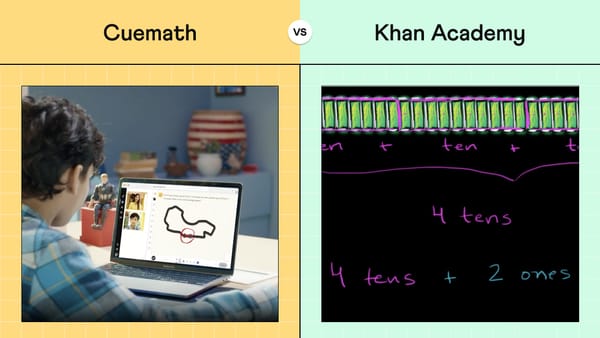
Cuemath is the only platform in this list that combines interactive concept learning, games and puzzles, and a live human tutor, all three in one place. Every class is 1:1 with a certified math tutor who works on a shared visual whiteboard, guiding students to discover answers through their own reasoning rather than handing them solutions.
Between classes, students use the Cuemath games app for logic puzzles and interactive challenges that reinforce concepts in a playful way. It is not a passive video platform or a worksheet drill, it is real-time tutoring that adapts in the moment to exactly what your child understands or does not.
Class Details: 2 live sessions/week, 55–60 minutes each, with the same dedicated tutor throughout. Aligned to US Common Core and state standards.
Pricing: Starting at $200/month. Free trial class available.
✅ What works well
- Only platform with live 1:1 human instruction on this list
- Conceptual teaching — child learns why, not just what to click
- Interactive games and logic puzzles between sessions keep learning going daily
- Detailed parent progress-tracking app
- 200,000+ students globally; 4.9+ Trustpilot rating (9,000+ reviews)
⚠️ Be aware of these
- Expensive compared to free math websites available ($1,800–$3,000+/year), usually paid upfront
- Most tutors are India-based; some students find it overwhelming to understand the accent.
- Tutor quality varies, so parents can vet carefully during the free trial before committing
Your Child Deserves a Math Tutor Who Actually Adapts
Every platform on this list has its strengths, but none of them can do what a live tutor can: notice when your child is confused before they give up. Try a FREE live Cuemath class today.
Book a Free Class200,000+ students · 9,000+ Trustpilot reviews · 4.9+ rating · 80+ countries
2. SplashLearn: Best Game-Based Platform with On-Demand Tutoring
SplashLearn lands at #2 for the same reason it's used in 1 in 3 US schools: kids genuinely want to use it. Its 4,000+ curriculum-aligned games turn concepts like fractions, place value, and multiplication into interactive adventures. The adaptive algorithm watches how a child plays and quietly adjusts difficulty — so a child who breezes through addition gets harder problems, and one who struggles gets scaffolded support.
The feature that pushes SplashLearn into Tier 1: optional live tutoring at $20/session. Not a subscription — just book when your child needs a real person to explain something.
Pricing: Teachers 100% free. Parents: 7-day free trial, then ~$59.99/yr (Math) or ~$89.99/yr (Math + Reading). Live tutoring: $20/session on demand. Watch auto-renewal settings — complaints are widespread.
✅ What works well
- Kids voluntarily play — highest home engagement of any free/low-cost platform
- On-demand live tutoring at $20/session with no subscription required
- 4,000+ games that teach concepts, not just test them
- Completely free for classroom teachers; ad-free and COPPA-compliant
⚠️ Be aware of these
- Concept scaffolding at Grades 4–5 is thinner — games feel like "animated worksheets" at higher levels
- Auto-renewal subscription complaints are widespread — check settings after signup
- Not a standalone curriculum — best paired with school instruction or Khan Academy
These platforms teach math concepts through games, videos, puzzles, and interactive activities. No live tutoring, but several are completely free and carry strong research backing. For many families, this tier is all they need.
3. Khan Academy: Best Free Math Website
Khan Academy is completely free, teaches concepts through short videos followed by interactive practice exercises, and offers Khanmigo — an AI tutor for $4/month that asks Socratic questions instead of giving away answers. It's the best free foundation for K–5 math that exists.
The Khan Academy Kids app (separate, also free) is built for ages 2–8 with Stanford education researchers — zero ads, zero in-app purchases, 180,000+ five-star reviews.
✅ What works well
- Completely free — no ads, no upsells, nonprofit
- Khanmigo AI tutor asks Socratic questions — teaches thinking, not just clicking
- Works as a complete K–5 curriculum for homeschooling families
- Khan Academy Kids: Common Sense Media Top Rated, Apple Editor's Choice
⚠️ Be aware of these
- No live human interaction — young children need adult support to stay on track
- Video format feels less playful than game-based platforms
- Kids app and main platform are separate apps with different accounts
4. Prodigy Math: RPG Game, All Math Content Free
Prodigy is the platform children ask to play — a full fantasy RPG where math is the mechanic. Students battle monsters by answering math questions, level up characters, and explore a game world. All 1,500+ educational skills are completely free. Paid memberships unlock only cosmetic items and add zero educational value.
An independent analysis found 16 upsell prompts in 19 minutes of gameplay. Every math problem, skill, and lesson is identical whether you pay or not. You do not need to pay.
✅ What works well
- Highest natural engagement — kids play by choice, not obligation
- All educational content genuinely free
- Visual hints teach concepts when kids get answers wrong
- Strong adaptive algorithm; used in ~25% of North American public elementary schools
⚠️ Be aware of these
- Aggressive freemium model — formally criticized by Fairplay for child-directed upsell pressure
- Kids may rush through math problems to get back to the game
- No direct instruction — purely practice and exploration
5. Math Playground: Best Free Supplement for Word Problems
Math Playground has been a trusted free resource since 2002. The standout feature is Thinking Blocks — a visual word problem tool that teaches children to model problems with tape diagrams before solving, building exactly the conceptual thinking US standards prioritize. Hundreds of games, virtual manipulatives, and logic puzzles, all free, no account required.
Pricing: All content free on desktop. Premium: $4/month for ad-free access — the best value upgrade on this entire list.
✅ What works well
- "Thinking Blocks" is the best free word problem modeling tool available anywhere
- No account required — just open the browser and start
- COPPA-compliant and kidSAFE-certified; no content paywall
⚠️ Be aware of these
- Ads in free desktop version; no progress tracking or parent dashboard
- No adaptive difficulty — same experience for all children
6. DreamBox: Best Adaptive Technology
DreamBox is the most technically sophisticated adaptive platform on this list. Its Intelligent Adaptive Learning engine doesn't just track right/wrong answers — it watches which manipulatives your child uses, how many steps they take, and where they hesitate. Concepts are introduced through virtual manipulatives (base-10 blocks, number lines, area models) inside a gamified world.
Pricing: 14-day free trial. $12.95/month or $99.95/year (individual). $19.95/month or $149.95/year (up to 4 students).
✅ What works well
- Analyzes problem-solving process — the deepest adaptive technology on this list
- ESSA "Strong Evidence" rating — independently validated research
- Virtual manipulatives teach concepts concretely before abstractly
⚠️ Be aware of these
- Sequential progression — can't jump to a specific topic without going through the sequence
- Engagement drops for many students at Grades 3–4
- At $100+/year, free alternatives like Khan Academy cover the same concepts adequately
7. PBS Kids Math: Free Option for Ages 2–8
PBS Kids Math is publicly funded, zero ads, and developed with US Department of Education grants requiring proven effectiveness. Games feature beloved characters — Peg + Cat, Odd Squad, Cyberchase, Curious George — embedding math in narrative and play. No membership upsells, no data selling, no ads. It just teaches.
✅ What works well
- Completely free and zero ads — the safest platform on this list by a wide margin
- Research-backed and government-validated; Cyberchase is Emmy Award-winning
- Beloved characters make engagement effortless for young children
⚠️ Be aware of these
- Very limited above Grade 3 — not useful for Grades 4–5
- No progress tracking or adaptive difficulty
8. Mathigon / Polypad: Best Virtual Manipulatives (Free)
Mathigon's Polypad is what math educators actually use and recommend — virtual manipulatives including base-10 blocks, fraction circles, algebra tiles, tangram shapes, and number lines, all free in a browser. It's the only platform specifically recommended by Math For Love (Dan Finkel) and endorsed by NCTM. Now integrated into the Desmos ecosystem.
Important framing: this isn't a self-directed game. It's a thinking tool — best used as a 15-minute parent-and-child exploration session. "Let's use the fraction circles to see why ½ is bigger than ¼" is exactly what this is designed for.
✅ What works well
- The best virtual manipulatives available anywhere — free, no account required, no ads
- Only platform on this list recommended by Math For Love and endorsed by NCTM
- Builds genuine conceptual understanding, not surface-level pattern matching
⚠️ Be aware of these
- Not self-directed — requires adult facilitation to be useful
- No progress tracking, curriculum, or guided path for independent child use
9. Beast Academy: Best for Gifted and Advanced Learners
Beast Academy unfolds as a comic book where monster characters work through math problems, make mistakes, argue about strategies, and reason out loud. Problems are rich and non-routine — they require actual thinking, not procedure-following. This is not a platform for on-level or struggling students. AoPS explicitly designed it for advanced and gifted learners who are bored by grade-level material.
Pricing: Online: $99.99/year (all Levels 1–5). Sibling discount: $64.99/yr. Print + online bundle: ~$160/level.
✅ What works well
- The most rigorous elementary math curriculum available anywhere
- Comic-book format children genuinely request to read by choice
- Introduces variables, combinatorics, and probability years ahead of typical curricula
⚠️ Be aware of these
- Not appropriate for on-level or struggling students — be honest about this before purchasing
- High reading demands — the graphic novel format requires above-grade reading ability
- Can overwhelm even strong students if started too early
10. Zearn: Best Classroom Blended-Learning Tool
Zearn is a nonprofit digital curriculum used by 1 in 4 US elementary students, free for teachers, and built on Eureka Math. Digital lessons include animated on-screen instruction, interactive visual models, and digital manipulatives — children are genuinely taught concepts, not just quizzed. It's #10 specifically because it's designed as a classroom blended-learning tool — it works best paired with teacher-led instruction rather than standalone at home.
✅ What works well
- ESSA Tier 1 — strongest research evidence of any platform on this entire list
- Free for teachers; #1 most-used math app in ThinkFives teacher survey
- Spanish lesson plans available — great for ELL families
⚠️ Be aware of these
- "Tower of Power" practice resets on wrong answers — frustrating for many children
- Designed for classroom blended learning — standalone home use is less effective
These platforms are useful for a narrow purpose: reinforcing skills already learned or building fact fluency specifically. They are not where your child will first encounter and understand a concept through play. Use them alongside the platforms above.
11. IXL: Best for Targeted Math Practice
IXL has 9,000+ skills with granular targeting — excellent for identifying exactly which skill a child is missing. It is a drill platform, not a concept-teaching platform. The SmartScore system is widely documented to cause anxiety; large point drops from a single wrong answer are a known issue. Use it for 10–15 minute targeted sessions, not extended daily practice.
✅ What works well
- 9,000+ skills with granular targeting — the best diagnostic tool on this list
- Aligned to both CCSS and every state's specific standards
⚠️ Be aware of these
- SmartScore drops scores sharply on wrong answers — documented to cause tears and anxiety in children
- Drill platform only — does not teach concepts; repetitive after 10–15 minutes
12. Reflex Math: Best for Fact Fluency (School-Based)
Reflex does one thing — math fact fluency for the four operations — and does it better than any other tool. Research evidence is strong. It is narrow by design. If speed-based fact games cause your child stress, consider MathFactLab (free) instead, which uses strategy and models rather than timed recall.
13. ABCya: Casual Practice and Screen-Time Reward
ABCya has 300+ COPPA-certified games that are fine for casual practice. The mobile app significantly increased its paywall in 2025 — only 6 rotating free games per week. Good for 10–15 minutes of fun on a desktop browser; not a serious learning tool. No progress tracking, no instruction, no adaptive difficulty.
Side-by-Side Comparison: All 13 Platforms
Ranked by what parents are looking for in interactive, game-based concept learning actually needs.
| # | Platform | Grades | Games/Puzzles | Teaches Concepts | Live Tutor | Free? | Best Cost |
|---|---|---|---|---|---|---|---|
| 1 | Cuemath | K–12 | ✓ | ✓✓ | ★ 1:1 live | ✗ | ~$200/mo |
| 2 | SplashLearn | PreK–5 | ✓✓ | ✓ | On-demand $20 | Teachers free | $60–90/yr |
| 3 | Khan Academy | PreK–12 | ✓ | ✓✓ | AI $4/mo | ✓ Free | Free |
| 4 | Prodigy Math | 1–8 | ✓✓ | ✓ | ✗ | ✓ Free | Free |
| 5 | Math Playground | PreK–6 | ✓✓ | ✓ | ✗ | ✓ Free | Free / $4/mo |
| 6 | DreamBox | K–8 | ✓ | ✓✓ | ✗ | Trial only | $100/yr |
| 7 | PBS Kids Math | Ages 2–8 | ✓✓ | ✓ | ✗ | ✓ Free | Free |
| 8 | Mathigon/Polypad | K–12 | Exploration | ✓✓ | ✗ | ✓ Free | Free |
| 9 | Beast Academy | Levels 1–5 | ✓ | ✓✓ | Group classes | ✗ | $100/yr |
| 10 | Zearn | K–8 | ✓ | ✓✓ | ✗ | Teachers free | Free (teachers) |
| 11 | IXL | PreK–12 | ✗ | Drills only | ✗ | ✗ | $79–159/yr |
| 12 | Reflex Math | 2–6 | ✓ | Facts only | ✗ | ✗ | School license |
| 13 | ABCya | PreK–6 | ✓ | Practice only | ✗ | Desktop only | Free (desktop) |
✓✓ = strong · ✓ = present · ★ = standout · ✗ = absent. Highlighted rows = Tier 1. Dimmed rows = supplemental tools.
Which Math Website is Right for Your Child?
Start here based on your situation, then use the combination tip below to build a stack that covers all your bases.
Free options only ($0)
- Khan Academy — all grades, full curriculum
- Prodigy — Grades 1–6, high engagement
- PBS Kids Math — PreK–3, safe & ad-free
- Math Playground — Grades 1–6, games + puzzles
- Mathigon / Polypad — visual exploration (with parent)
Games & fun first
- Prodigy — RPG format kids love (free)
- SplashLearn — 4,000+ engaging games
- Math Playground — games + puzzles (free)
- PBS Kids — beloved characters, ages 2–8 (free)
Real teacher involved
- Cuemath — live 1:1, dedicated tutor (~$200/mo)
- SplashLearn Live — on-demand ($20/session)
- Khan Academy + Khanmigo — AI Socratic tutor ($4/mo)
Child is PreK–Grade 2
- Khan Academy Kids — free, Stanford-designed
- PBS Kids Math — free, zero ads
- SplashLearn — most engaging for this age
Child is advanced or gifted
- Beast Academy — gold standard for gifted K–5
- Mathigon — deep exploration tool (free)
- Zearn accelerated track
Fact fluency specifically
- MathFactLab — free, strategy-based (less anxiety)
- Reflex Math — most effective, speed-based (school)
- Khan Academy — fact fluency built in (free)
Khan Academy (free) for new concept instruction. SplashLearn or Prodigy (free to low-cost) for daily practice that feels like play. Mathigon / Polypad for a weekly 15-minute hands-on exploration session with a parent. Add Cuemath if you want a live tutor in the mix, or SplashLearn's on-demand tutoring at $20/session when a specific concept isn't clicking.
Your Child Deserves a Math Tutor Who Actually Adapts
Every platform on this list has its strengths — but none of them can do what a live tutor can: notice when your child is confused before they give up. Try a FREE live Cuemath class today.
Book a Free Class200,000+ students · 9,000+ Trustpilot reviews · 4.9+ rating · 80+ countries
Frequently Asked Questions
My child plays Prodigy but doesn't seem to be learning, just playing. Is it working?
This is worth monitoring. Prodigy's design can lead children to rush through math problems to get back to the game, which reduces learning quality. Check the parent dashboard — look at accuracy rates (below 70% consistently means the concept isn't landing). Prodigy is best for reinforcing concepts already introduced, not for first-time learning. Pair it with Khan Academy for the teaching component.
Should I pay for Prodigy's membership?
No. All educational content in Prodigy is completely free. Paid memberships ($59–$119/year) unlock only cosmetic game items — pets, gear, avatar customization — that add zero educational value. An independent analysis found 16 upsell prompts in 19 minutes of gameplay. You do not need to pay.
Is Khan Academy actually as good as a paid math platform?
For concept instruction, yes — it's genuinely comprehensive, Common Core-aligned, and the $4/month Khanmigo AI tutor adds meaningful Socratic guidance. Where paid platforms add value is in engagement: if your child needs games and visuals to stay motivated, Khan Academy's video-plus-exercise format may not be enough on its own. Use it for instruction and pair it with a game-based platform for practice.
Is Cuemath worth the high cost?
That depends on what you need. Cuemath is the only platform here offering genuine live 1:1 tutoring with a dedicated teacher — if that's what your child needs, $200 per month is comparable to hiring a private tutor independently. The caveats are real: most tutors are India-based, customer service complaints are documented, and plans require large upfront commitments. Do the free trial class, assess tutor quality carefully before committing to an annual plan, and compare against local tutors in your area.
What's the best free math website for elementary students?
The best free math website for elementary students is Khan Academy for instruction — it's a complete K–5 curriculum aligned to Common Core. Pair it with Prodigy or SplashLearn for game-based engagement, and Mathigon/Polypad for hands-on concept exploration with a parent. All are free and Common Core aligned. That combination covers everything a K–5 child needs outside of school.
My child is bored and ahead of the class, what math website should I use?
Beast Academy, without hesitation — it's the only K–5 curriculum with the depth and rigor to genuinely challenge advanced learners, and kids love the comic-book format. Make sure your child is a strong reader first, as the graphic novel format has significant reading demands. Start at Level 2 or 3 regardless of grade — the difficulty ramps quickly.
Sources
- NAEP Mathematics Report Card — National Center for Education Statistics
- Common Core State Standards — Mathematics (corestandards.org)
- What Works Clearinghouse — ESSA Evidence Standards (IES/ED.gov)
- Cuemath on Trustpilot — 9,000+ reviews, 4.9+ stars
- Khan Academy — About & Research
- COPPA Rule — FTC.gov
- National Council of Teachers of Mathematics (NCTM)
- PBS Kids — US Department of Education Ready To Learn program